
Index KP of the sun
KP Index and drone flights. Check before you take off.
Geomagnetic activity can affect satellite navigation. Check the KP index and learn how to factor it into your pre-flight preparations.
Latest KP index chart
Check the reading and timestamp shown on the chart before your flight.
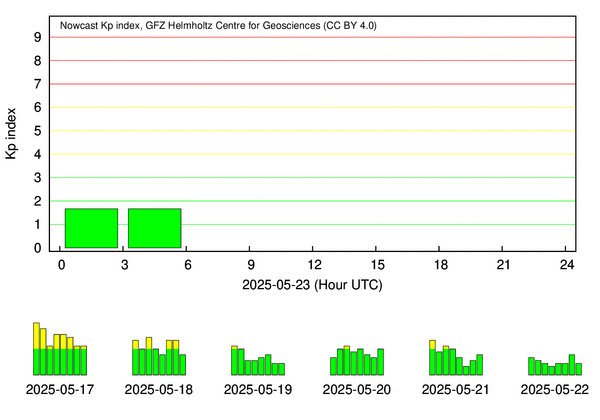
This chart comes from an external source and may be updated with a delay. Check the measurement time shown on the chart. If the data is missing or appears outdated, do not rely on it when deciding whether to fly.
Low global geomagnetic activity. This does not guarantee reliable GPS performance or a safe flight.
Geomagnetic activity is elevated. Pay closer attention to warnings and navigation performance.
From KP 5, NOAA classifies conditions as a geomagnetic storm. Take extra precautions and consider postponing your flight.
What exactly is the KP index?
KP measures Earth’s geomagnetic activity on a scale from 0 to 9. It is based on measurements of magnetic-field fluctuations and describes conditions in three-hour intervals.
During geomagnetic storms, disturbances in the ionosphere can increase errors in GNSS satellite positioning (including GPS). However, a specific KP value does not mean that any particular drone will necessarily lose its position.
Flight performance also depends on satellite visibility, surroundings, local interference, compass performance, wind and the condition of the aircraft.
Check more than just KP.
Three quick checks to make before every drone flight in Poland.
Check airspace and flight rules
Check the airspace restrictions and required notifications for your planned location.
DroneTower – flight information and check-in ↗Check the weather and KP
Review the wind, precipitation and visibility forecast. Before take-off, also check the KP chart above and its timestamp.
Back to the KP chart ↑Check your drone before flying
Check app warnings, GNSS and compass status, batteries and the conditions needed for Return to Home (RTH).
Ask the MEGADRON team ↗KP index – pilots’ questions
Can I fly a drone when KP is 3?
KP 3 indicates relatively quiet geomagnetic conditions, but whether you can fly also depends on regulations, airspace restrictions, local weather and drone condition.
Does KP 5 mean flights are prohibited?
Not by itself. It marks the beginning of a geomagnetic storm on NOAA’s scale and is a reason to take extra care when planning a flight.
Can a high KP value interfere with GPS?
Geomagnetic storms can cause GNSS signal errors and interference. The impact depends on conditions and the specific receiver.
How often does the KP index change?
The standard KP index describes geomagnetic activity in three-hour periods. Estimates and visualizations on different services may be updated more frequently.
It is worth clearing up any doubts before take-off, especially about GNSS, the compass and RTH.