
Humanoid robot—what can a modern humanoid really do?
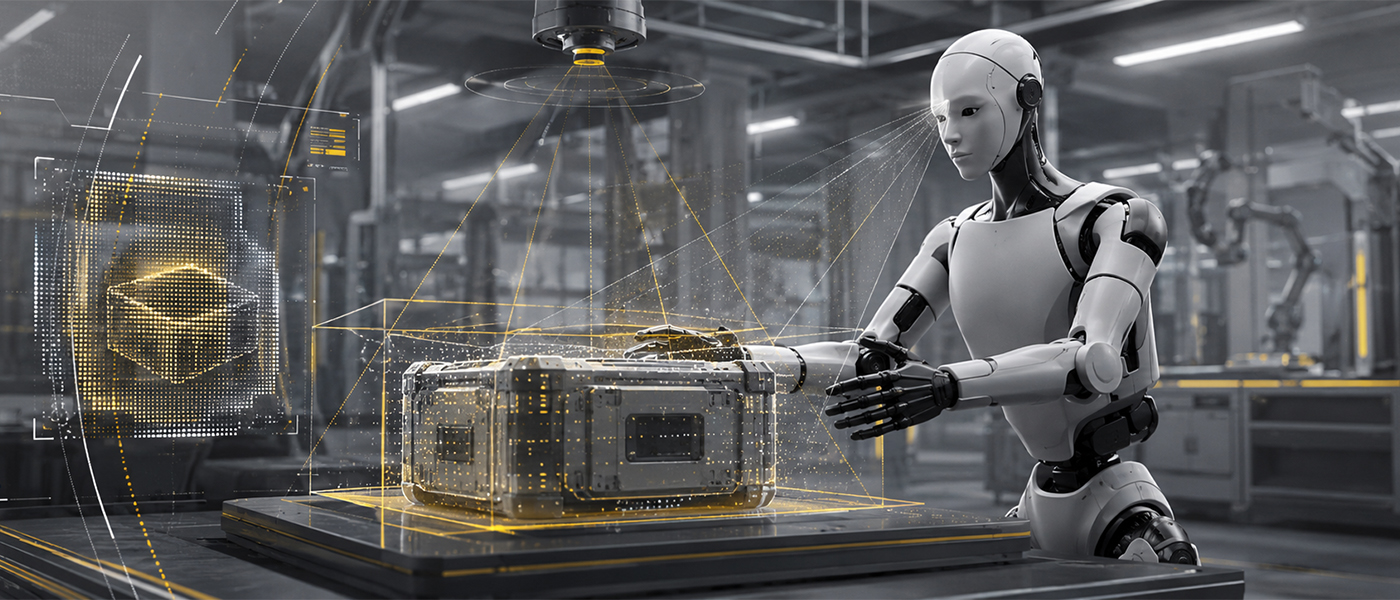
Humanoid robot Just a few years ago, it was primarily associated with a laboratory or a science fiction movie. Today, it can walk, maintain its balance, recognize its surroundings, manipulate objects, and serve as a platform for training AI models. However, this does not mean that, right out of the box, it can replace a factory worker on its own.
And this is the most important thing you should know before making a purchase.
A modern humanoid is, above all, a highly advanced hardware-and-software platform, which is selected, configured, and integrated for a specific task. Models such as the Unitree R1, G1, and H2 differ in terms of dimensions, number of degrees of freedom, payload capacity, sensors, operating time, and programmability.
What's more, a humanoid isn't always the best choice. If your primary needs are mobility, inspection, or working in difficult terrain, a quadruped robot it might make a lot more sense.
In this article, we'll show you where today's robotics capabilities truly lie.
What Is a Humanoid Robot??
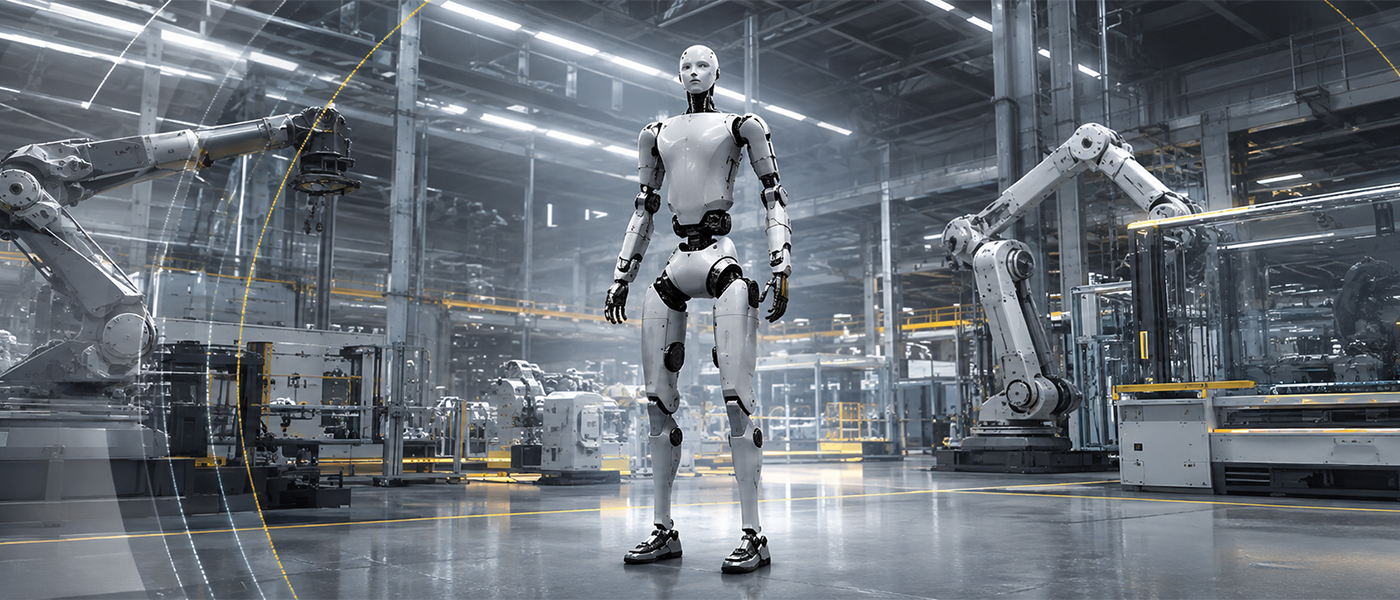
A humanoid robot is a robot designed so that its structure and manner of movement partially mimic those of a human being. It usually has two legs, two arms, a movable torso, and a set of cameras and sensors that allow it to observe its surroundings.
Why complicate the design and build a robot on two legs when industrial machines have been managing just fine without them for decades??
Because a vast part of our world was designed specifically for humans. The door handles are at hand height. The shelves are of a specific height. The buttons are located on the operator panels. The boxes are on the floor. The tools have handles designed to fit the human hand. Stairs and walkways connect the workstations.
A classic industrial robot works great when the environment is set up for it. Humanoid is trying to reverse this logic: instead of redesigning the environment for the robot, we build a robot capable of functioning in a human environment.
That is precisely why this design is so interesting to industry, logistics, and artificial intelligence research and development.
A humanoid robot or a quadruped robot—which is better??
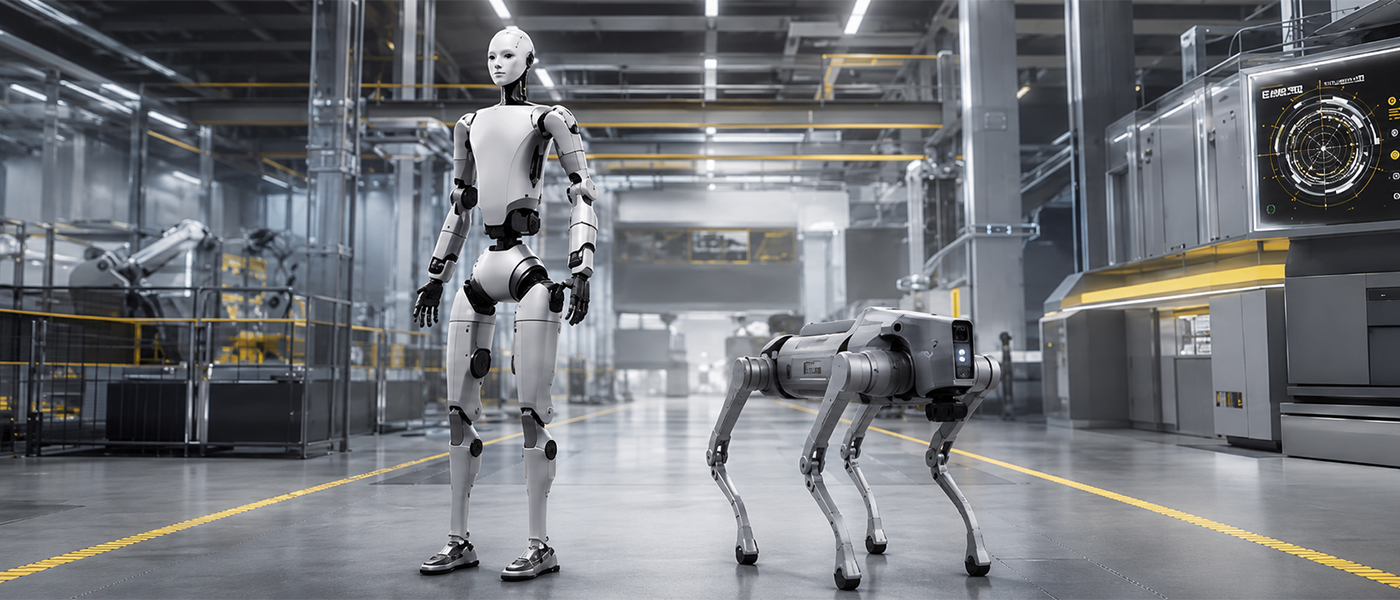
It depends primarily on the task.
A humanoid has an advantage whenever you need to manipulate objects and use infrastructure designed for humans. He or she can approach the workstation, reach for an item, operate a handle, or press a button.
Four-legged robot However, it works better when mobility, stability, and the movement of sensors or payloads are the priority.
A good example is the Unitree A2. The current version weighs about 42 kg with the battery, has 12 powered degrees of freedom, and can carry about 25 kg while in motion. Without a load, the manufacturer claims over 5 hours of continuous operation and a range of approximately 20 km; with a 25 kg load, over 3 hours and approximately 12.5 km. The maximum static load is approximately 100 kg.
So if you want to patrol the facility, conduct inspections, transport equipment, or navigate rough terrain, a four-legged companion might be a better choice. If a robot is to use tools, lift objects, or work alongside a human—that's when a humanoid design starts to make sense.
Unitree R1, G1, and H2 - Comparison
| Robot |
|
|
|
|---|---|---|---|
| Height | 123 cm | 132 cm | 182 cm |
| Weight including the battery | ok. 29 kg* | ok. 35 kg | ok. 70 kg |
| Degrees of freedom | 26 | 23 | 31 |
| Development versions | R1 EDU: 26–40 DoF | G1 EDU: 23–43 DoF | H2 EDU |
| Arm | 5 DoF | 5 DoF | 7 DoF |
| Leg | 6 DoF | 6 DoF | 6 DoF |
| Perception | binocular camera | depth camera + 3D LiDAR | binocular camera |
| Arm lifting capacity | depends on the configuration | ok. 2 kg | ok. 7 kg (nominal) / approx.. 15 kg for the time being |
| Battery | lithium, quick-change | 9,000 mAh | 15 Ah / 0.972 kWh |
| Rated operating time | ok. 1 hour | ok. 2 hours | ok. 3 hours |
| Main Application | education, research, presentations | advances in robotics, AI, and manipulation | full-scale platform, research, and applications requiring a longer range |
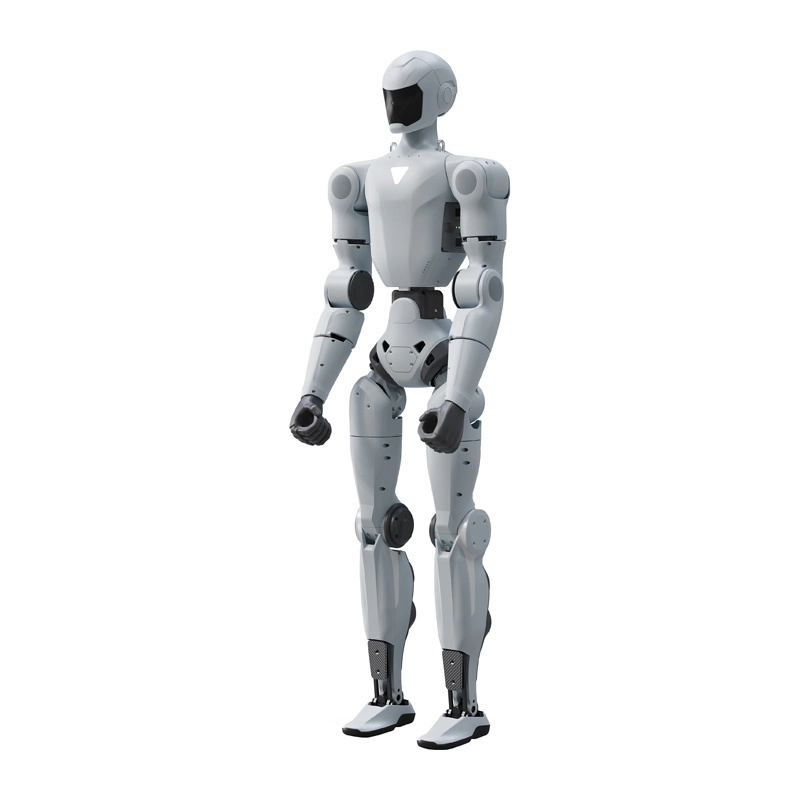
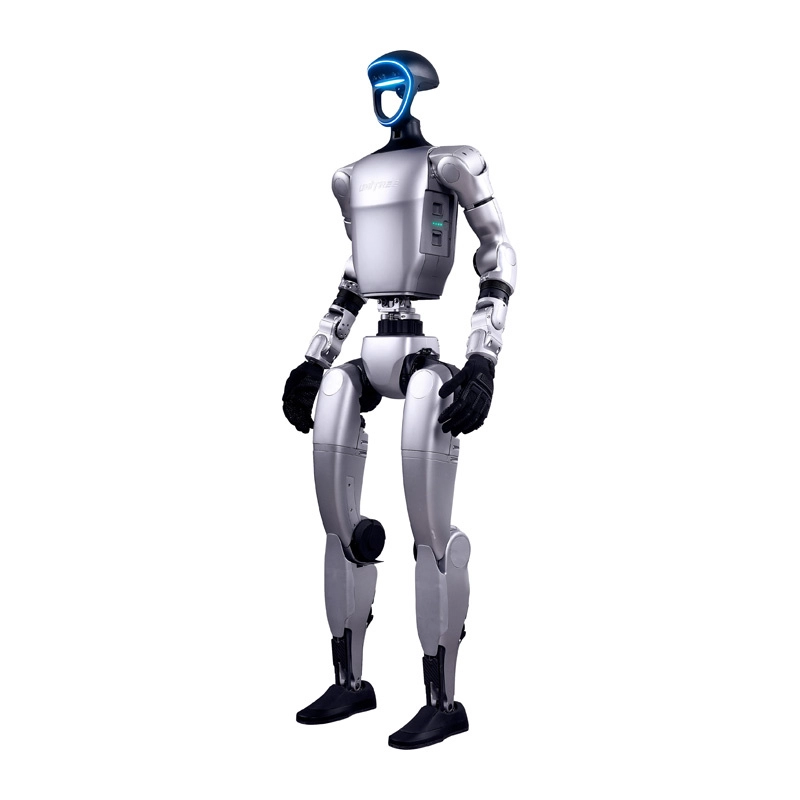
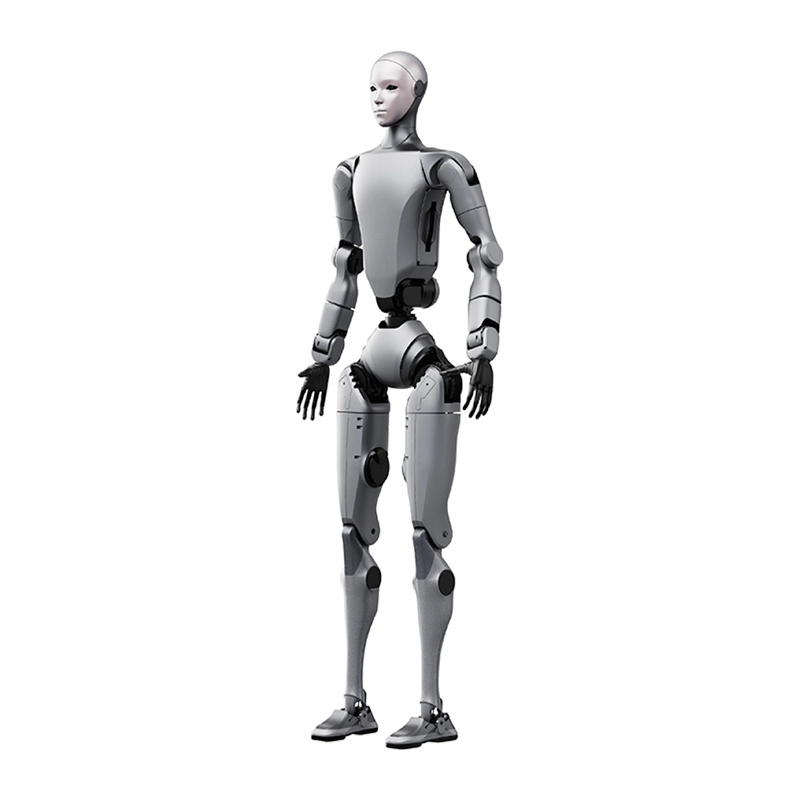
*The figures apply to the standard R1; the R1 AIR weighs about 27 kg. Specifications may vary depending on the configuration.
Unitree R1 — a good starting point for exploring the world of humanoids

The Unitree R1 is the smallest of the humanoids we've described. It is 123 cm tall, and the standard version weighs about 29 kg. The R1 offers 26 degrees of freedom, while the R1 EDU can have between 26 and 40, depending on the configuration. The manufacturer claims approximately one hour of battery life.
What exactly do degrees of freedom mean??
Simply put, they indicate how many independent axes of motion the robot has. Your arm doesn't make a single movement. The shoulder, elbow, and wrist move, followed by the fingers. The robot needs the right motors and joints to perform a similar sequence. Therefore, a greater number of degrees of freedom allows for more complex movements, but at the same time increases the complexity of control.
For us, R1 is, above all, an interesting platform for education, research into control systems and AI, and demonstrations. If you're just starting a project with a humanoid, its small size can be a big advantage.
Unitree G1 — When You Really Want to Advance Robotics
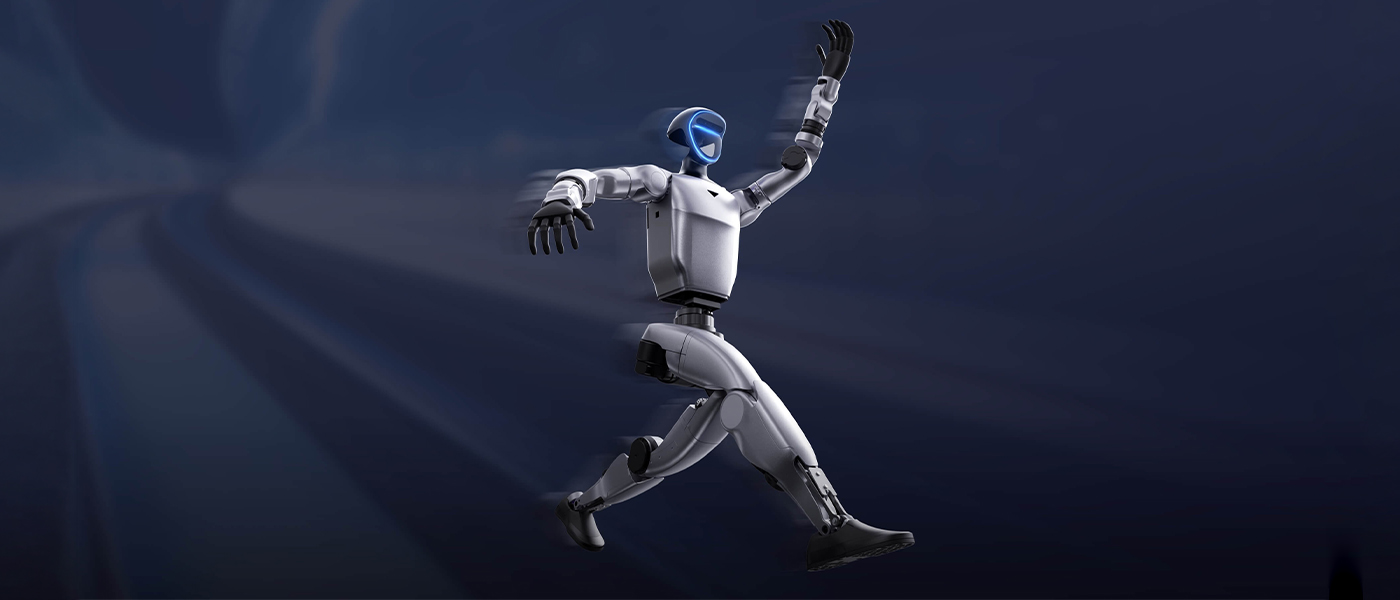
The Unitree G1 is about 132 cm tall and weighs about 35 kg. The standard G1 has 23 degrees of freedom, while the G1 EDU variant has between 23 and 43, depending on the configuration. A major difference compared to R1 lies in perception. The G1 uses a depth camera and 3D LiDAR, that allow it to gather spatial information about its surroundings.
Its battery has a capacity of 9,000 mAh, is quick to replace, and has a claimed runtime of about two hours. The maximum load per arm is approximately 2 kg for the G1 and approximately 3 kg for the G1 EDU, although the manufacturer clearly states that the actual value depends heavily on the arm's position.
G1 EDU also enables further development of the platform and the use of additional computing units, including solutions from the NVIDIA Orin family. For us, the G1 is one of the most interesting options between a compact educational humanoid and a large platform designed for use in human spaces.
Unitree H2 - a full-size humanoid robot
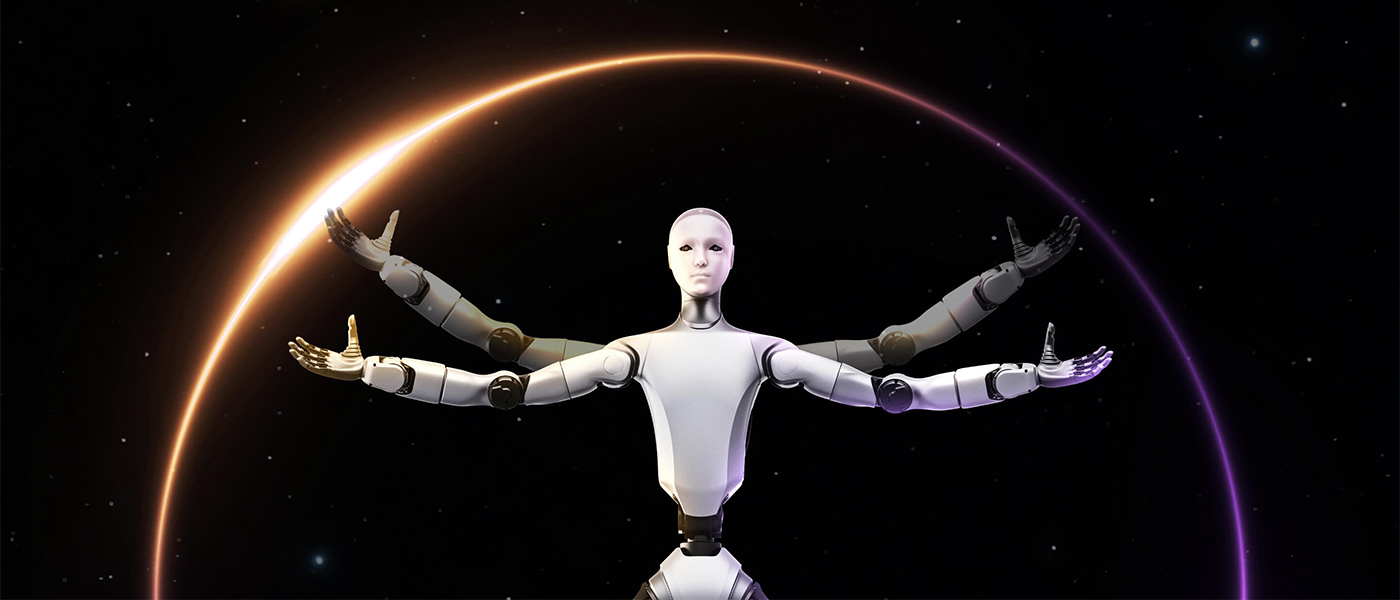
The Unitree H2 is 182 cm tall and weighs about 70 kg. These dimensions are already very close to those of an adult.
The robot has 31 degrees of freedom: 6 for each leg, 7 for each arm, 3 for the torso, and 2 for the head. The maximum torque of the strongest leg joint is 360 N·m, and that of the arm is 120 N·m. The manufacturer specifies the arm's rated load capacity as approximately 7 kg and its peak load capacity as approximately 15 kg. The battery has a capacity of 15 Ah, or 0.972 kWh, and the stated runtime is approximately 3 hours.
This is a platform that not only looks like a human but also has the necessary range of motion and strength for more demanding experiments involving manipulation. However, it's worth noting the configuration. The standard H2 does not automatically come equipped with dexterous hands—the manufacturer provides additional manipulators m.in. for EDU variants.
10 Uses for Humanoid Robots in a Factory
The most important question, however, is not: “How many degrees of freedom does the robot have?”?", but what can you do with them??
1. Pick & place - picking up and setting down components
A person picks up an object from the table practically without thinking. The robot must first detect the object, determine its position, plan the arm's trajectory, select a gripping method, pick up the object, and set it down safely.
Humanoids can be developed in this very direction, especially when combined with a vision system and an appropriate manipulator.
However, this does not mean that any object will be lifted correctly without prior configuration. The type of gripper, the geometry of the object, and the way it is positioned are of great importance.
2. Sorting Products and Components
The vision system can identify objects based on their shape, color, size, location, or product category, and the robot can then move them to the appropriate locations.
Unitree directly markets the Industrial H2-D as a platform for m.in. for high-speed sorting, automation, and warehousing.
3. Machine Operation
One of the most interesting scenarios is machine tending, or the operation of other machines.
The robot can be configured to open the cover, retrieve the finished part, load a new semi-finished product, or operate a simple panel. Why is this humanoid interesting?? Since the machine has already been designed for humans.
So you don't have to build an entire workstation from scratch for a standard industrial arm. Don't treat this as a plug-and-play feature, though. Programming, machine integration, safety procedures, and thorough process testing are required.
4. Putting Together Kits
A screw, washer, wire, gasket, and housing component—before assembly, someone often has to prepare a specific set of components.
It's easy for a person, but it gets very monotonous after thousands of repetitions.
A robot equipped with a vision system and an appropriate gripper can be configured to pick up various components and assemble production kits.
5. Transporting components between workstations
A classic industrial robot arm has one major drawback: it operates only where it is installed.
A mobile humanoid robot can change its position.
The Unitree H2-D takes it even further—it’s a platform with two seven-axis arms and a mobile base. The mobile version can move at speeds of up to 1.5 m/s, rotate in place, and operate in a space ranging from floor level to approximately 2 meters. The rated load capacity of a single arm is approximately 7 kg.
6. Quality Control
The robot's cameras can be used as part of a mobile vision system. The robot can approach the product and observe it from several angles instead of requiring a separate set of cameras to be installed at each inspection point.
Once an appropriate vision model has been implemented, a similar system can be developed, for example, to detect missing components, visible damage, or to verify the use of specific protective equipment.
The key word, however, is: developed. Simply purchasing a humanoid does not automatically provide a ready-made quality control or occupational safety and health system.
7. Picking up objects from different heights
The box can be on the floor, part of it on the table, and the next component on a tall shelf.
For humans, this is a normal work environment. For traditional automation—a much more challenging environment. The H2-D points to an interesting direction here. The adjustable height of the base and a tilt range of up to 115° allow you to extend the workspace from the floor to approximately 2 m.
8. Buttons, handles, doors, and simple tools
Control panels, door handles, and grips are designed to fit the human hand.
A humanoid robot equipped with a sufficiently mobile arm and an appropriate end-effector can be adapted to use such infrastructure without requiring a complete overhaul of it. And this is precisely where the humanoid design begins to offer a real advantage over many other types of robots.
9. Monotonous and repetitive tasks
The most valuable robot in a factory isn't always the one that can do a somersault.
A robot that correctly transfers the same part from a container to a holder for the thousandth time may be much more important.
In our opinion, it is precisely these repeatable and well-defined processes that are one of the best places to start implementing a humanoid.. You can easily determine the correct answer to a problem and identify a mistake.
10. Learning New Tasks and Embodied AI
This is probably the most important direction for the development of the entire industry.
G1 is being developed using imitation learning and reinforcement learning—that is, learning by demonstration and learning by reinforcement, respectively. The G1-D illustrates this even better. Unitree is building a process around this platform that includes data collection, training, simulation, and the subsequent deployment of the model on a robot.
Simply put, this means that instead of manually defining every centimeter of the motion trajectory, we can collect examples of correct performance and use them to train the model. This is a huge change compared to traditional automation.
However, this does not mean that it is enough to show the robot a task just once, and from that point on it will perform it flawlessly. You still need data, training, testing, and monitoring of behavior in unusual situations.
What does the robot see, and how does it know where an object is located??
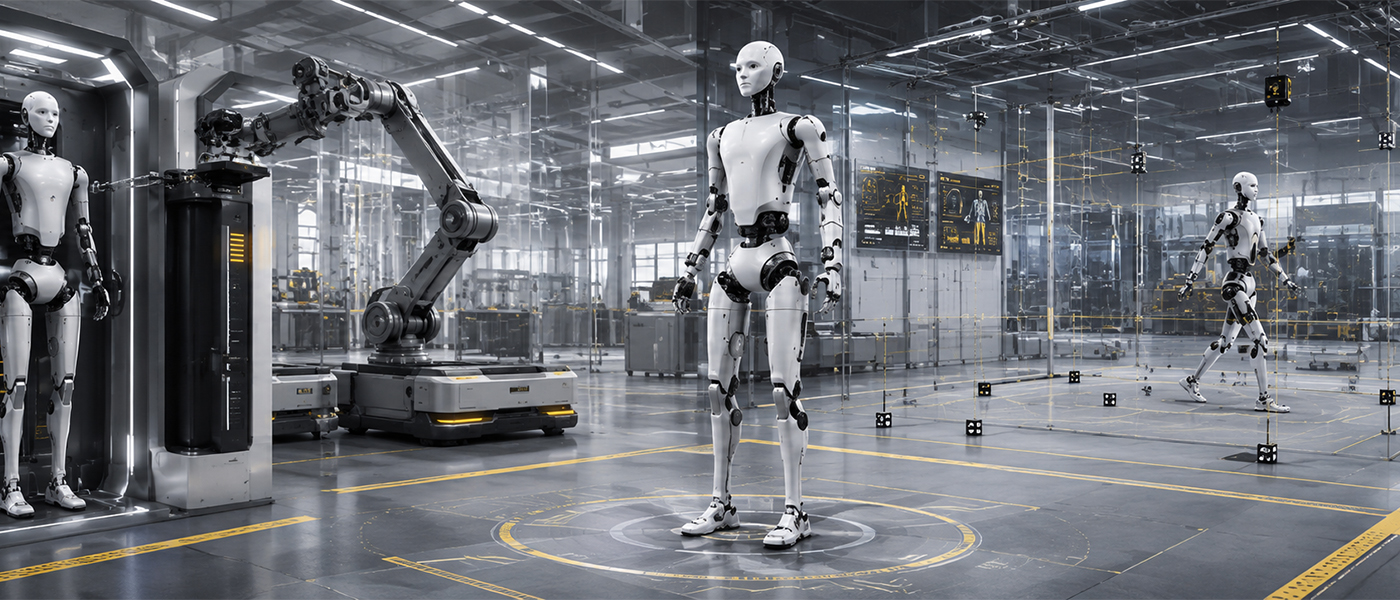
Mechanics is only half the problem.
The robot still needs to understand its surroundings. The G1 uses a depth camera and 3D LiDAR. The H2 uses a wide-angle binocular camera, while the more industrial-grade H2-D combines imagery with LiDAR, ultrasonic sensors, force data, and a voice interaction system.
You can think of these elements as equivalents of the human senses:
- camera – allows you to observe your surroundings and identify objects,
- LiDAR – measures the geometry of space and distances,
- encoders – provide the robot with information about the position of its own joints,
- force sensors – allow you to control contact with objects,
- IMU – provides the information needed to m.in. for orientation and movement control.
Only the combination of perception, motor control, and an appropriate decision-making model makes it possible to do something that seems trivial to a human: see a box, walk over to it, and pick it up.
The Greatest Limitations of Modern Humanoids
It's worth keeping your feet on the ground here.
The duration is still limited
About one hour for R1, two hours for G1, or three hours for H2 is still significantly less than a full production shift. Swappable batteries help, but charging infrastructure and work organization still matter.
Manipulation is harder than walking
A spectacular video of a running humanoid demonstrates the capabilities of motion control, but production often presents even greater challenges.
Grasping a thin wire, inserting a part into a tight socket, or manipulating a malleable material may require excellent perception, precise hand movements, and an appropriate control model.
A humanoid is not a ready-made employee
You're buying a platform, not a trained operator.
You need to define the process, select a manipulator, prepare the software, teach the robot how to behave, and integrate it into its environment.
Security must be built in from the start
A 70-kilogram robot with joints capable of generating hundreds of newton-meters of torque is not a toy.
Unitree itself emphasizes the need to maintain an appropriate distance and exercise caution when using humanoids. The manufacturer also notes that the industry is still in a relatively early stage, and some of the features presented are currently in development or being tested.
And that’s exactly why, in professional applications, we prefer to start by asking “What process do you want to perform?”?”, instead of “which robot looks best”?”.
Humanoid robots – pros and cons
Pros
- can function in a space designed for humans
- combines mobility with the ability to manipulate objects
- could potentially handle several different positions
- provides a high degree of flexibility in research and AI projects
- allows you to test imitation learning, reinforcement learning, and embodied AI
- may reduce the need to redesign the entire workstation to accommodate a traditional industrial robot
Cons
- requires programming and integration
- Battery life is still limited
- Precise manipulation remains a major challenge
- The implementation requires a security analysis
- The price of the robot itself is not the total cost of the project
- A manufacturer's impressive demonstrations do not always translate directly into a finished industrial process
How much does a humanoid robot cost??
The price of a humanoid robot depends primarily on its size, configuration, type of manipulators, and software development capabilities.
As of the time this material was prepared at MEGADRON:
- Unitree R1 Basic – 49,000 PLN gross
- Unitree G1 Basic – 99,000 PLN gross
- Unitree H2 – 220,000 PLN (gross)
EDU variants, additional workstations, computing units, and other equipment can significantly affect the price of the entire solution. That's why it's a mistake to focus solely on the price of the robot itself. An industrial project must also take into account integration, software, workstation setup, hardware, testing, and subsequent system maintenance.
Availability depends on the specific model. Some of the robots are in the supplier's warehouse, while others are ordered on demand; therefore, it's a good idea to check with us for the current lead time before making a purchase.
How to Choose a Humanoid Robot?
Don't start with the specifications.
Start with the task.
If the robot is to serve as a platform for learning, demonstrations, and initial experiments with humanoids, the R1 will be a much more sensible starting point than the full-size H2. If you're developing perception, manipulation, or embodied AI algorithms and need LiDAR, a depth camera, and extensive programming capabilities, look no further than the G1 EDU.
If arm reach, strength, and working in a space designed for an adult are key factors, the H2 offers significantly greater mechanical capabilities. And if a robot doesn't need arms at all, but should be able to walk for long periods, carry sensors, and navigate rough terrain—check to see if a quadruped robot A tool like the Unitree A2 won't simply be a better tool.
That's much more important than choosing a robot based on the most impressive video on the internet.
Will a humanoid robot replace humans??
We wouldn't expect a scenario in which humanoids suddenly replace entire teams of employees. It is much more realistic to automate individual tasks.
First, those that are repetitive, predictable, easily verifiable, and require physical manipulation. A person, on the other hand, can be responsible for overseeing the process, handling exceptions, ensuring quality control, and managing several robots simultaneously. It's less spectacular than the vision of a factory without people, but definitely more realistic.
Which robot should I choose?? Our recommendation
If you're just starting out and want to enter the world of humanoids as sensibly as possible— Unitree R1 is an interesting educational and research platform.
If you're interested in developing your own software, perception, manipulation, and AI projects—look first and foremost at Unitree G1 EDU and the configuration required for your specific task.
If you need a full-size design, greater range, and significantly higher lifting capacity— Unitree H2 It's a whole different class of platform.
However, if your main task is inspection, patrolling, or transporting sensors, we wouldn't insist on two legs. The Unitree A2 or another quadruped robot can do this job more easily and for longer.
At MEGADRON, we don't want to choose a robot for you based on which model looks the best in a movie. First, tell us exactly what the robot should do, where it should work, what it should lift, and how long it should operate. Only then can we make an informed choice regarding the platform, configuration, and equipment.
If you're interested in inspection automation using other autonomous platforms as well, check out our article DJI Dock 3 After Half a Year in the Field—What the System Review Revealed?.