Drone Regulations 2026 — Everything You Need to Know

In this article, we explain the drone regulations applicable in Poland. You will learn what changes have been introduced to protect public and private interests while enabling the development of drones in various fields. Check out drone law 2026, where you will discover how EASA Member States (including Poland) shape regulations to effectively protect the public while ensuring privacy and respecting human rights.
Table of contents:
Regulations applicable to the open and specific categories
- During what period do EU Regulations 2019/947 and 2019/945 apply?
- Who is a drone operator?
- What types of drones does the regulation apply to?
- When is a drone considered a toy?
- What is the difference between an autonomous drone and an automatic drone?
- Who is an uninvolved person?
- What is an assembly of people?
- What is covered by the EU regulation?
- Can an EASA Member State maintain national drone regulations in parallel with the new European drone regulations?
- Are certificates issued in the United Kingdom for UAS, including pilot training, accepted in the EU in 2025?
- Do I need to register my drone?
- What happens after registration?
- How do I register as a drone operator?
- Do I need drone insurance?
- Which number should be placed on the drone and how should it be displayed?
- What is the difference between an operator number and a pilot number?
- Does every drone require registration?
- Does every drone flight have to be reported?
- What are the penalties for flying a drone in violation of the regulations?
- Will my registration as a drone operator be recognized throughout Europe?
- I fly model aircraft. How can I fly my model?
- Can I fly my drone wherever I want?
- Can I fly over people?
- How high can I fly my drone?
- Geographical zones (where can I fly) — how do I know whether I can fly in a given location?
- Is there a minimum age for flying a drone?
- Can drones without a class label still be used?
- Are there exceptions allowing classless drones to be operated after January 1, 2024?
- Are there legal consequences for operating a drone without a class label?
- Can drones without a class label be legally sold in Poland?
- How do I determine whether I fall under the open category?
- I am in the "open" category — how can I determine which subcategory I can fly in?
- Can classless drones weighing less than 250 g still be used in the "open" category?
- I bought a DJI Mini drone (weight 249 g). How can I operate it?
- What are the requirements in the subcategories of the "open" category?
- Who issues the remote pilot competency certificate for the "open" category and how long is it valid?
- Will the competency certificate for the "open" category be recognized throughout Europe?
- What training do I need to fly a drone in the open category?
- Do I need authorization before flying a drone in the "open" category?
- What are my responsibilities as a drone operator in the "open" category?
- What are my responsibilities as a pilot in the "open" category?
- What should I do when buying a drone for use in the open category or in a standard scenario (STS) of the specific category?
- Do I still need training in the "open" category if I was already flying drones before the regulations came into force?
- My drone is not certified. Can I fly my old drone in 2025?
- I am interested in drone racing and/or flying drones with goggles (FPV) in the "open" category.
- Is flying with goggles (first-person view) allowed in the "open" category?
- I build my own drones. Can they be used in the "open" category?
- I plan to provide services (commercial and otherwise) using drones. How can I determine whether I can operate in the "open" or "specific" category?
- I am a non-EU resident visiting Europe and I plan to fly my drone in the "open" category. Do I need to register?
- As a non-EU resident, are my competencies in the "open" category recognized in the EU?
- How do I determine whether I fall under the "specific" category?
- Training requirements in the "specific" category — are all pilots in the "specific" category required to train to fly a drone?
- Who issues the pilot competency certificate for the "specific" category and how long is it valid?
- Will the competency certificate for the "specific" category be recognized throughout Europe?
- Do I need authorization before flying a drone in the "specific" category?
- I am in the "specific" category. How can I obtain authorization?
- What are my responsibilities as a drone operator in the "specific" category?
- What are my responsibilities as a pilot in the "specific" category?
- Can I fly my old drone in the "specific" category in 2025?
- Do I still need training in the "specific" category if I was already flying drones before the regulations came into force?
- I am interested in drone racing and/or flying drones with goggles (FPV) in the "specific" category. What authorization do I need?
- Is flying with goggles (first-person view) allowed in the "specific" category?
- Can spectators be present during operations in the "specific" category?
- I build my own drones. Can mine be used in the "specific" category?
- I plan to provide services (commercial and otherwise) using drones in the "specific" category. Will I need to validate my operational authorization in every other EASA Member State?
- I am a non-EU resident visiting Europe and I plan to fly my drone in the "specific" category. Do I need to register?
- As a non-EU resident, are my competencies in the "specific" category recognized in the EU?
- What is an LUC?
- Who can apply for an LUC?
- Do I need authorization before flying a drone? (LUC)
- How long is an LUC valid?
- What does the process of applying for operational authorization look like?
- I am a drone manufacturer and need to flight-test my product to obtain a class marking. Do I need to apply for special operational authorization?
- How can I fly a drone above 120 metres?
Drones with C0-C6 class identification labels
- Are drones with class identification labels available in the EU?
- How should a manufacturer demonstrate compliance with EU regulations?
- As an individual user, how do I know what matters when checking a class identification label?
- What are the obligations of importers and distributors?
- Do drones with class identification labels have to operate in a specific category?
- What can happen if I buy a drone with an incorrect class marking?
Drone operation categories — open, specific and certified
Open Category — this is the most accessible category and does not require submitting declarations to the Civil Aviation Authority. It covers low-risk operations and is the category in which most recreational flights and many commercial drone flightsare carried out. It includes operations within the pilot's visual line of sight (VLOS) or with the help of an observer, using drones weighing up to 25 kg. Flights may take place at a maximum of 120 metres above the ground. However, operator registration is required for UAS when drones weigh more than 250 g or are equipped with a camera or other sensors that collect data. This category is divided into subcategories A1, A2 and A3.
Specific Category — covers higher-risk operations intended for flights that go beyond the limitations of the open category, for example operations beyond visual line of sight (BVLOS). It requires operator registration for the UAS and, depending on the nature of the mission, meeting one of the following conditions:
- submitting a declaration that the operation complies with a standard scenario (STS or NSTS)
- obtaining authorization for an operation in the specific category
- holding an LUC certificate
Certified Category — applies to operations with the highest level of risk. It may include, among other things, operations over assemblies of people, transport of people or carriage of dangerous goods where, in the event of an accident, they could pose a high risk to third parties. In such cases, certification of the drone and operator and an appropriate pilot licence may be required.
Who is a drone operator?
A drone operator is a natural person or legal entity that owns or rents one or more drones. You may be both the drone operator and the pilot if you are also the person who actually flies the drone.
You can also be a pilot without being the drone operator, for example if you are a pilot working for a company that provides drone-based services. In that case, the company is the drone operator and you are the pilot. If you bought a drone to fly in your spare time, you are both the drone operator and the pilot. If you bought a drone as a gift, the person who receives the gift and then flies the drone will be both the drone operator and the pilot.
The operator and the pilot therefore do not have to be the same person. This matters, among other things, for registration, marking the drone with the operator number, liability insurance and determining responsibility for the operation.
What types of drones does the regulation apply to?
The regulation covers all types of aircraft without a pilot on board, including radio-controlled flying models (powered fixed-wing aircraft, helicopters, gliders, RPAS), regardless of whether they are equipped with a camera.
A drone is an unmanned aircraft (UAS), meaning an aircraft operating or designed to operate autonomously or to be remotely controlled without a pilot on board. The regulation applies to:
- aerial work
- urban air mobility
- recreational flights, including model aircraft
- international IFR flights
RPAS (Remotely Piloted Aircraft Systems) are a subcategory of UAS that includes fully autonomous drones that fly entirely on their own without the need for pilot intervention.
Regulatory reference: Article 3(30) of Regulation (EU) 2018/1139 / Article 2(1) of EU Regulation 2019/947 and Article 3(3) of EU Regulation 2019/945.
When is a drone considered a toy?
A drone is considered a toy if it may be attractive to a child. More precisely, products designed or intended exclusively for use in play by children under 14 years of age are considered toys and must comply with Directive 2009/48/EC on the safety of toys. A drone's compliance with this directive is declared in the relevant EU declaration of conformity. In case of doubt, whether a product should be considered a toy is assessed by market surveillance authorities based on a number of features relating to its attractiveness to children, accessibility, etc.
Manufacturers may, however, explicitly exclude their product from the scope of the Toy Safety Directive (where confusion is possible) by clearly stating a minimum age > 13 years on the product, packaging or instructions, for example "not for use by children under 14".
Legal reference: Article 2 of Directive 2009/48/EC of the European Parliament and of the Council of 18 June 2009 on the safety of toys.
What is the difference between an autonomous drone and an automatic drone?
An autonomous drone is capable of carrying out operations without pilot intervention, including when unforeseen situations occur. This differs from automaticoperations, in which the drone flies along predefined routes that you set before the flight begins. With this type of drone, you must be able to take control and intervene in unforeseen events for which the drone has not been programmed.
Automatic operations may be carried out in the open category, provided that all other requirements of this category are met. Fully autonomous operations are not allowed in the open category — they may be carried out in the specific or certified category once the relevant requirements are met.
Who is an uninvolved person?
An uninvolved person is someone who does not participate in the UAS operation or who is not aware of the instructions and precautionsprovided by the drone operator. Examples of uninvolved persons:
- spectators at sporting events, concerts or other mass events
- people on a beach, in a park or walking along streets
An uninvolved person is not only someone directly exposed to the drone, but may also be a person in a bus, car, etc. if they are indirectly exposed. For example, if a drone flies over a car, its driver should be considered an "uninvolved person". This is because a drone flying near a car, even if it does not strike it, may distract the driver and thereby cause a road accident.
Regulatory reference: GM1 Article 2(18) Definitions, ED Decision 2019/021/R.
Who is an involved person?
A person is considered involved if they choose to take part in the operation, understand the risks and are able to monitor the drone's position during flight. Therefore, to be considered an "involved" person in the operation, they must:
- express consent to participate in the operation (for example, consent to a drone overflight); the consent must be explicit
- receive instructions and precautions from the drone operator/pilot on what to do in an emergency
- not be occupied with other activitiesthat would prevent them from monitoring the drone's position and, in the event of an incident, taking action to avoid being struck.
Simply writing on a notice that a drone will be used during an event is not considered sufficient, because the drone operator must obtain individual, explicit consent and ensure that people understand the risks and the procedures to be followed in an emergency. During the operation, involved persons are expected to follow the drone's flight and be ready to take protective action in the event of unexpected drone behaviour. If, during a UAS operation, people are busy working or watching something in a way that is incompatible with monitoring the drone's flight, they cannot be considered involved persons.
Regulatory reference: GM1 Article 2(18) Definitions, ED Decision 2019/021/R.
What is an assembly of people?
An assembly of people is a crowd. It is not defined by a specific number of persons, but by whether individuals are able to move away in order to avoid the consequences of a drone going out of control. If a group is large enough that the ability to freely escape or move away from the drone is limited, it is considered an assembly of people. Examples of assemblies of people include:
- sporting, cultural, religious or political events
- crowded beaches or parks
- busy shopping streets during store opening hours
- crowded ski resorts / ski slopes
Regulatory reference: GM1 Article 2(3) Definitions, ED Decision 2019/021/R.
What is covered by the EU regulation?
EU regulations take a risk-based approach and therefore do not distinguish between recreational and commercial activities. They take into account the weight and specifications of the drone as well as the operation it is intended to perform. The rules apply to drones placed on the market:
For operations in the "open" category:
- those bearing a class identification label (in accordance with Regulation (EU) 2019/945) from 0 to 6, from lighter to heavier models
- those built privately
- those placed on the market before 31 December 2023
For operations in the "specific" category, all drones falling within that category, including those without a class identification label.
EU Regulation 2019/947 covers most types of operations and their risk levels. It does so through three operation categories: "open", "specific" and "certified".
Can an EASA Member State maintain national drone regulations in parallel with the new European drone regulations?
The EU drone regulation is a legal act that became applicable in all EU Member States on 31 December 2020, replacing national rules and making them no longer applicable. However, European drone regulations give Member States some flexibility to adopt measures specifying certain aspects, such as:
- the minimum age of a remote pilot
- conversion of certificates issued before the EU regulation entered into force
- authorization of model aircraft clubs and associations
- fines for infringements of the regulation
- use of geographical zones
- insurance
EASA Member States may not introduce further drone rules on matters already regulated by the European drone regulation. In Poland, additional requirements concern, among other things, geographical zones, flight reporting, the minimum pilot age and mandatory third-party liability insurance for certain operators.
Are certificates issued in the United Kingdom for UAS, including pilot training, accepted in the EU in 2025?
Since 1 January 2021, the United Kingdom has no longer been part of the EASA system and, for the purposes of EU drone regulations, is treated as a third country. This means that pilot competency certificates and operator documents issued in the United Kingdom are not automatically recognized in European Union Member States.
A UK operator wishing to carry out flights in the EU must comply with EU rules. As a general rule, they should also register in the first EU Member State in which they intend to conduct an operation if that operation requires operator registration.
Do I need to register my drone?
In most cases, the drone itself is not registered — it is the operator who must register. In the open category, you must register as an operator if you use a drone:
- with a maximum take-off mass of 250 g or more,
- that, in the event of impact, can transfer more than 80 J of kinetic energy to a person,
- equipped with a camera or another sensor capable of collecting personal data — regardless of its mass, unless it is a toy compliant with Directive 2009/48/EC.
This means that operator registration is also required for many popular drones weighing less than 250 g if they are equipped with a camera and are not toys.
Example: DJI Mini 4 Pro weighs less than 249 g but is equipped with a camera and is not a toy. Therefore, a person who wants to fly it legally in Poland must register as a drone operator.
In the specific category, operator registration is mandatory regardless of the weight of the drone used. Operator registration is free and is carried out in the National Drone Information System (KSID) at drony.gov.pl. The operator registers only once, regardless of how many drones they own.
A drone is certified when it has an airworthiness certificate (or restricted airworthiness certificate) issued by the national civil aviation authority. In such a case, registration is required. A certified drone is needed only when the risk of the operation requires it.
Relevant regulation: Article 21 of EU Regulation 2019/947.
What happens after registration?
After registration you will receive a "drone operator number", which must be displayed as a sticker or inscription on all drones you own, including privately built ones. It must be applied in a legible and durable manner and should be visible during an inspection. If, due to the small size of the drone, the marking cannot be placed on its exterior, it may instead be placed, for example, inside an easily accessible battery compartment.
Remember that the operator number is not the same as the pilot number. You must also upload it to the "remote drone identification system". In Poland, after the registration number is issued, it is transmitted and stored automatically immediately after successful registration.
Regulatory reference: Article 14 of EU Regulation 2019/947.
How do I register as a drone operator?
Drone operator registration is free and is carried out at drony.gov.pl. It applies to operators carrying out flights in the "open" category with drones weighing 250 g or more, drones capable of transferring more than 80 joules of kinetic energy, and drones equipped with a camera, unless they meet the requirements of Toy Directive 2009/48/EC. In the "specific" category, registration is required regardless of drone weight.
Registration conditions:
- the pilot must be at least 14 years old
- the operator registers if their place of residence or business is located in Poland.
- operators registered in the EU/EFTA may create an account in the Polish system by providing their operator number
- operators from outside the EU/EFTA may register if they plan to carry out their first operation in Poland
- registration is possible in only one EU Member State
If you live in Poland or Poland is your principal place of business, you register in the Polish system. If you are already registered as an operator in another EU or EFTA country, you do not register again in Poland — one operator registration is valid in the other countries of the EASA system.
You can find detailed information in our article How to register as a drone operator — step by step.
Do I need drone insurance?
Yes. Under the amendment to the Aviation Law, operators who own a drone weighing from 250 g to 20 kg are required to have third-party liability insurance. The requirement applies from 13 November 2025. Insurance limits have been set out in a regulation of the Minister of Finance. One of the cheapest and most affordable drone insurance options can be found at AeroPolisa.
Check drone liability insurance
The insurance obligation rests with the drone operator. If you run a company and are both the owner and operator of the drone, the people controlling it as pilots do not need additional third-party liability insurance. Although many offers refer to "pilot liability insurance", this wording is often misleading — in practice, the policy concerns the operator's liability. If you want to learn more, contact us or read our article on this subject.
Is my registration as a drone operator valid throughout Europe?
Yes, as a drone operator you will receive a unique registration numberthat is valid in all other EASA Member States. You cannot register twice.
Regulatory reference: Article 14 of EU Regulation 2019/947.
Which number should be placed on the drone and how should it be displayed?
The drone must display the operator numberthat you receive during registration. It is important that the number is:
- clearly visible,
- durable
- resistant to damage — so that it can be easily read during an inspection.
If your drone is so small that it is difficult to place the marking in a visible location, or if it is a faithful scale model of a real aircraft and the marking would spoil its appearance, the number may be placed inside the battery compartment, provided that it is easily accessible.
What is the difference between an operator number and a pilot number?
Operator number is a unique identifier assigned to a registered drone operator. This is the number that must be placed on the drone and entered into remote e-identification systems, where applicable.
Pilot number is the individual number of a document confirming that a person has the appropriate qualifications to fly a drone, for example A1/A3, A2 or STS qualifications.
In short, the operator number identifies the drone operator, while the pilot number confirms the pilot's qualifications.
Does every drone require registration?
Not every drone itself must be registered. If your drone is not certified, you do not register the aircraft, but as the operator or owner you may still be required to register. Registration is free and is carried out through the system drony.gov.pl.
Importantly, operator registration is a one-time process, regardless of how many drones you own in the "open" or "specific" category. You do not need to register if your drone:
- weighs less than 250 g and does not have a camera or another sensor capable of collecting personal data
- even if it has a camera, weighs less than 250 g but is classified as a toy under Directive 2009/48/EC
Commission Implementing Regulation (EU) 2019/947 of 24 May 2019, which lays down rules for the operation of drones in the European Union.
Does every drone flight have to be reported?
Yes, in accordance with Guideline No. 17 of the President of the Civil Aviation Authority of 6 June 2023 and the provisions of the Act of 16 April 2020 (Article 15zzzzl), every unmanned aircraft (UAS) flight in Polish airspace must be reported.
Before starting a flight you must submit a notification, the so-called check-in, using the ICT system designated by PANSA. Currently, this is done through the DroneTower application. The reporting requirement applies to all UAS — regardless of whether you fly a light drone under 250 g, a larger drone with a camera or a model aircraft.
Before take-off, it is also worth checking the current geographical zones and restrictions applicable at the planned flight location. This can be done using DroneMap or the information available in DroneTower. Completing a check-in does not automatically mean that the flight is permitted. In some zones, additional restrictions may apply or prior permission may be required before the operation can be carried out.
What are the penalties for flying a drone in violation of the regulations?
Breaching drone flight regulations may result in a financial penalty. Depending on the type of infringement, this may include both fines and substantial financial penalties. The rules are intended to improve safety in the airspace and therefore cover, among other things, flying in prohibited zones or failing to register as required under the regulations.
It is better not to find out the hard way how much a seemingly minor mistake can cost. Before every flight, check the current zones, operating conditions and required documents. A detailed table listing the penalties and their amounts can be found in our article: Fine for flying a drone — how high are the penalties?
I fly model aircraft. How can I fly my model?
Model aeroplanes, gliders and helicopters are also covered by the regulations on unmanned aircraft. Depending on the type of model and the flight location, several options are available. Model flights are most often carried out in subcategory A3 of the open category. This may include Class C4 models, privately built aircraft with a maximum take-off mass below 25 kg and certain older models without a class marking. In A3, flights must be conducted away from uninvolved persons and at least 150 m from residential, commercial, industrial and recreational areas.
Model aircraft pilots may also fly:
- in specially designated geographical zones,
- within a model aircraft club or association holding the appropriate authorization from the President of the Civil Aviation Authority.
For flights carried out within a club or association, the conditions specified in its authorization apply and may differ from the standard restrictions of the open category.
Can I fly my drone wherever I want?
No. Whether a flight can be carried out depends not only on the class of the drone and the pilot's qualifications, but also on the geographical zone applicable at the planned operation location. Geographical zones may:
- completely prohibit flights,
- allow flights only if specified conditions are met,
- require additional permission,
- limit the maximum altitude or other parameters of the operation.
Therefore, before every flight you should check the current situation at the take-off location. In Poland, official information on drone zones is available in DroneMap, and before starting the flight you must also perform the required check-in using DroneTower. We have described geographical zones in detail in this article.
Regulatory reference: Article 15 and UAS.OPEN.060(4) of EU Regulation 2019/94.
Can I fly over people?
When operating in the "open" category, you may not fly over uninvolved people unless you have a privately built drone weighing less than 250 g or a drone purchased on the market with a C0 or C1 class identification label. In every case, try to minimize the time spent flying over people.
If you have a Class C2 drone in subcategory A2, you should keep the drone at a distance no less than the altitude at which it is flying (the "1:1 rule" — for example, if the drone is at 40 m, the distance from uninvolved persons should be at least 40 m), and you should never fly less than 30 m horizontally from uninvolved persons. If the drone has a low-speed mode and it is active, you may fly as close as 5 m from uninvolved persons. For all other cases (drones with Class 3, 4, 5 or 6 identification labels, or privately built drones heavier than 250 g), make sure there are no uninvolved persons within the operating area.
Regulatory reference: Article 4(1)(c) and UAS.OPEN.040 of EU Regulation 2019/947.
How high can I fly my drone?
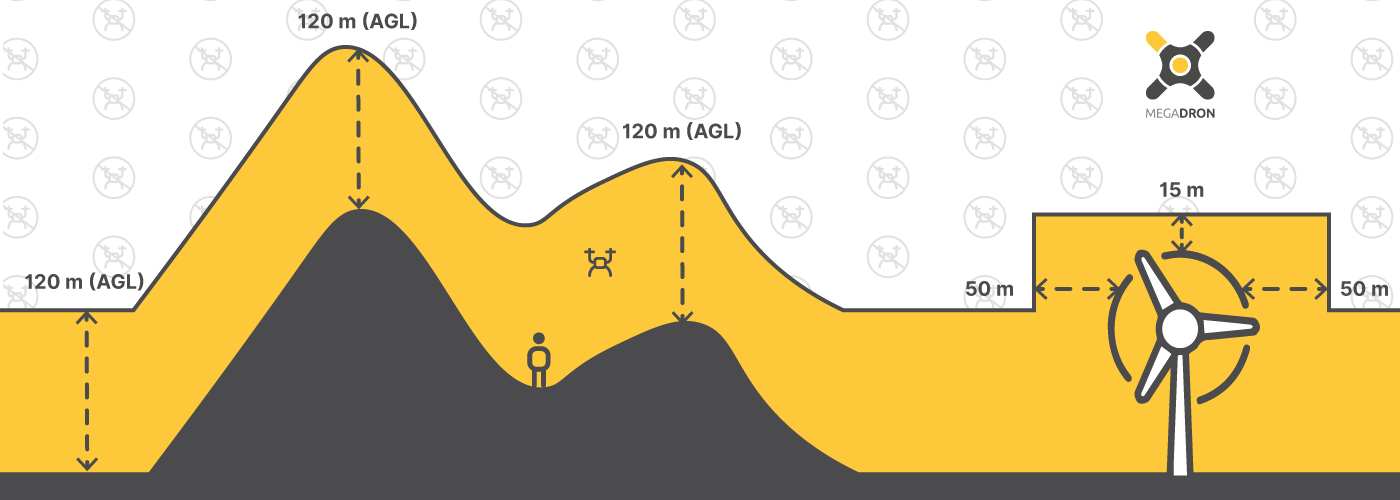
The maximum flight altitude in Poland is 120 m above ground level (AGL). Of course, you should make sure that the national aviation authority has not established a geographical zone with a lower limit in the area where you plan to fly. If you need to fly over an obstacle higher than 120 m, you may fly up to 15 metres above the obstacle, but only at the express request of the owner of the obstacle (for example, under an agreement with the owner to carry out an inspection). In that case, you may fly within a horizontal distance of 50 metres from the obstacle.
When operating in hilly terrain, the drone's height above the ground may be lower. You must keep the drone within 120 m of the nearest point of the terrain. This means that on a hilltop, for example, even if you keep the drone within 120 m of the hillside, you may actually be more than 120 m above the valley floor. As long as the drone remains within 120 m of the slope, the flight is legal.
Regulatory reference: UAS.OPEN.010(2)(3), Annex Part A to EU Regulation 2019/947.
Geographical zones (where can I fly) — how do I know whether I can fly in a particular location?
Flight authorization applies to all operations in the "open" or "specific" category and is issued by the authority designated by the relevant state (in Poland, the CAA/ULC). A state may restrict flights over a nature park or a higher-risk area such as an industrial site, prison, etc. Geographical zones are not fixed; their boundaries and the permissions required for flight may change.
Before starting a flight, you should always check the geographical zones and comply with them. In Poland, you can check the zones at https://dronemap.pansa.pl/. Select the view for UAS (Unmanned Aircraft Systems).
Currently, another mandatory step before flight is performing a check-in in the DroneTower application, which replaced the previous reporting tools. This process is required regardless of drone weight and allows a legal flight to be carried out at the selected location. You can read more about how to report a flight correctly in our article PANSA check-in — where and how to do it?.
Since January 2025, DJI has removed automatic flight restrictions in GEO No Fly Zones. This means that drones will no longer automatically prevent a flight, and full responsibility for compliance with the rules lies with the operator. The change gives pilots more freedom but also requires better preparation before each flight. More information about DJI's new policy and its impact on drone pilots can be found in the article End of GEO No Fly Zone restrictions in DJI — what do you need to know?.
You can learn more about abbreviations such as TRA and MCTR in our article Where can you fly a drone? Map of geographical zones.

Regulatory reference: Article 15 of EU Regulation 2019/947.
Is there a minimum age for flying a drone?
Yes. In Poland, the minimum age for a drone pilot is 14 years — lower than the standard age of 16 applicable in the European Union. However, minors must meet several conditions:
- Consent of a legal guardian — both for training and for taking the examination
- Supervision during examinations and training — the presence of a parent or guardian is required
In the European Union there areapplicable exceptions — the minimum age does not apply if:
- the drone weighs less than 250 g and is intended for private use
- the Class C0 drone is a toy under EU rules
- the flight takes place under the supervision of an adult pilot who meets the legal requirements
Poland has decided to reduce the minimum age to 14, but these rules apply only within Poland. If you plan to fly a drone abroad, remember that the rules of the country concerned apply — under the EU framework the standard minimum pilot age is 16.
Regulatory reference: Article 156zb of the Polish Aviation Law.
Can drones without a class label still be used?
Yes, but in the "open" category, classless drones may be operated only if they were placed on the market before 1 January 2024. If a drone has no class assigned and was placed on the market after that date, it may only be used in the "specific" category after obtaining the appropriate operational authorization.
Drones without a C0-C4 class markingthat were placed on the market before 1 January 2024may still be used in the open category:
- in A1 if their maximum take-off mass is less than 250 g,
- in A3 if their maximum take-off mass is less than 25 kg.
If you own a classless drone purchased before that date, you may continue to fly it under the basic operating rules. If you own a drone such as the DJI Mavic Air 2, DJI Mini 2 or DJI Phantom 4 Pro, you do not need to worry about the absence of an assigned class.
Are there exceptions allowing classless drones to be operated after January 1, 2024?
Yes, but only in the "specific" category. Classless drones may be used after 1 January 2024 if the operator obtains an individual operational authorization. However, they may not be used under the standard operational scenarios STS-01 and STS-02, which require drones with a class identification label (C5 or C6).
Are there legal consequences for operating a drone without a class label?
Yes. Operating drones in violation of the regulations may result in financial penalties. The rules provide for monetary penalties, among other things, for operating a drone without the required class in the "open" category and for failure by economic operators involved in the sale and distribution of equipment to fulfil their obligations.
These rules arise from:
- the Polish Aviation Law (Article 209un)
- the Act on conformity assessment systems and market surveillance
Can drones without a class label be legally sold in Poland?
Yes, classless drones may still be sold after 1 January 2024, but their operation is limited to the "specific" category and requires the appropriate authorization. Sellers should therefore inform customers about the current rules so that users do not unknowingly expose themselves to penalties.
Open category
How do I determine whether I fall under the open category?
A drone may be operated in the "open" category when:
- it bears one of the class identification labels Class 0, 1, 2, 3 or 4
- it is privately built and its weight is less than 25 kg
- it was purchased before 1 January 2024 without a class identification label, as described above
- it will not be operated directly over people unless it has a class identification or weighs less than 250 g. (See operation subcategories A1, A2 and A3 to find out where you can fly your drone.)
- it will be kept within visual line of sight (VLOS), or the remote pilot will be assisted by a UA observer
- it is flown at an altitude not exceeding 120 metres
- it does not carry dangerous goods or drop any material
The subcategory in which you may fly depends primarily on the drone's class, its weight and the way the operation is conducted.
Regulatory reference: Articles 4 and 20 of EU Regulation 2019/947; Annex Part A and Article 5(1) of EU Regulation 2019/947, Parts 1-5 of the Annex to EU Regulation 2019/945.
I am in the "open" category — how can I determine which subcategory I can fly in?
The subcategory is determined by:
- the class marking label (0, 1, 2, 3 or 4) attached to the drone
- the weight of the drone, in the case of a privately built drone or a drone without a class identification label
There are three subcategories in the open category:
A1 — flights may be carried out with:
- a C0 drone below 250 g (e.g. Mini 3/3 Pro, Mini 4/4 Pro),
- a C1 drone below 900 g (e.g. Air 3S),
- a privately built drone below 250 g,
- a classless drone below 250 g if it was placed on the market before 1 January 2024 (e.g. Mini 2 SE)
A2 — flights may be carried out with:
- a Class C2 drone,
- 30 m from an uninvolved person,
- 5 mif the drone has the relevant speed-limiting function and it is active.
A3 — flights may be carried out with:
- a Class C3 drone,
- a drone up to 25 kg,
- a privately built drone or a drone without a specified class
- 150 m from residential, commercial, industrial and recreational areas

Note: to facilitate the transition, drones without class identification labels could be flown until 1 January 2024 under the requirements set out in Article 22 of EU Regulation 2019/947.
Can classless drones weighing less than 250 g still be used in the "open" category?
No. Even if a drone weighs less than 250 g, if it was placed on the market after 1 January 2024 and has no assigned class, it may not be used in the "open" category. It may be operated only in the "specific" category after obtaining authorization.
If you have a classless drone purchased before 1 January 2024, you may continue to fly it under the basic operating rules. Examples include DJI Mavic Air 2, DJI Mini 2 and DJI Phantom 4 Pro — with these drones, you do not need to worry about the lack of an assigned class.
I have a drone under 250 g, e.g. DJI Mini (weight 249 g). How can I operate it?
DJI Mini drones weigh less than 249 g, have a camera and are not toys (which means they do not comply with the Toy Directive). Therefore, the following steps must be taken to comply with Regulation (EU) 2019/947:
- As the drone operator/owner, you must register with the national civil aviation authority.
- After registration you receive a "drone operator registration number", which must be displayed as a sticker on all drones you own, including privately built ones.
- When using the drone, you must always comply with the requirements of subcategory A1.
- If your drone has Class C0, you may fly it in subcategory A1. An A1/A3 certificate is not required — however, you must read the manufacturer's instructions and comply with the rules for A1 operations.
A remote pilot certificate is not required to operate this type of drone, although A1/A3 online training is recommended. If you are unsure about the subcategories, you can find more information here.
What are the requirements in the subcategories of the "open" category?
Depending on the drone's class identification label or, for privately built drones, its weight, drones may be operated under different conditions:
- Drones bearing the Class 0 CE mark or privately built drones weighing up to 250 g may be flown in subcategory A1, which means almost anywhere except over assemblies of people or in areas where the state has prohibited drone flights by establishing geographical restrictions.
- Drones with a Class 1 identification label may also be operated in subcategory A1, with the difference that flights over uninvolved persons must be minimized.
- Drones marked with Class identification 2 may be operated in subcategory A2, which means that in an urban environment you must keep a safe distance from uninvolved persons. As a general rule, this minimum distance should equal the altitude at which the drone is flying (for example, if you fly at 30 m, ensure that the nearest uninvolved person is at least 30 m from the point where the drone would fall vertically in an accident). In no case may the distance be less than 5 m. You may also fly under the conditions specified for subcategory A3. Avoid flying in areas prohibited by the state through drone flight restrictions.
- Drones bearing a identification Class 3 or 4 label, or privately built drones weighing up to 25 kg, may be operated in subcategory A3. This means that in practice they cannot be used in urban environments. Keep the drone at least 150 m away from residential, commercial or industrial areas and operate only in areas where there are no uninvolved persons within the area in which the drone may be flown. In every case, avoid areas where drone flights have been prohibited by the state.
Who issues the remote pilot competency certificate for the "open" category and how long is it valid?
In the "open" category, national aviation authorities are responsible for issuing certificates (in Poland, ULC). The remote pilot competency certificate is valid for 5 years. If renewal is completed before the certificate expires, the pilot may attend a seminar organized by ULC or an entity recognized by it; otherwise, competency must be demonstrated again.
Regulatory reference: DRONE.OPEN.070(1) of EU Regulation 2019/947.
Will the competency certificate for the "open" category be recognized throughout Europe?
Yes, training completed in one EASA Member State is recognized in all the others.
What training do I need to fly a drone in the open category?
The type of training required depends on the type of drone used. Each EASA Member State may define the relevant remote pilot training requirements in accordance with the table below:
| UAS (drone) | Operation | Drone operator / pilot | ||||
| Class | Maximum take-off mass | Subcategory | Operational limitations | Drone operator registration | Remote pilot competence | Minimum pilot age |
| privately built | < 250 g | A1 (may also be flown in subcategory A3) | - may fly over uninvolved persons (this should be avoided where possible)- no flying over assemblies of people | no, unless it has a camera/sensor or the drone is not a toy | no training required | no minimum age |
| 0 | read the instruction manual | 16*, no minimum age if the drone is a toy | ||||
| legacy drones | 16* | |||||
| 1 | < 900 g | - no planned flights over uninvolved persons (if this happens, the duration must be minimized)- no flying over assemblies of people | yes | - read the instruction manual - complete full online training - pass the online theoretical examination | 16* | |
| 2 | < 4 kg | A2 (may also be flown in subcategory A3) | - no flights over uninvolved persons - maintain a horizontal distance of 30 m from uninvolved persons (may be reduced to 5 m if low-speed mode is active) | yes | - read the instruction manual - complete full online training- pass the online theoretical examination - complete and declare practical self-training - pass a written examination at the CAA (or a recognized entity) | 16* |
| 3 | < 25 kg | A3 | - do not fly near people - fly outside urban areas (150 m distance) | yes | - read the instruction manual - complete full online training - pass the online theoretical examination | 16* |
| 4 | ||||||
| privately built | ||||||
| legacy drones | ||||||
Pilot training from 1 January 2024
If the subcategory in which you fly requires training, you can obtain one of the certificates compliant with EU regulations and bearing the EASA logo and use it to operate your drone in the "open" category in all EASA Member States. A1/A3 training is available through ULC. You can complete training and examinations in any EASA Member State of your choice.
You can obtain a UAS pilot competency certificate from a training centre authorized by ULC. Be careful: some illegal websites sell fake training certificates. Trust only training and examination providers listed on the ULC website!
No training is required if the drone you use:
- has a C0 class identification label
- is self-built (privately built) and has a maximum mass below 250 g
- was purchased before 31 December 2023, has no class marking and has a maximum mass below 250 g
However, you must read the manufacturer's instructions.
Certificate of completion of online training for the A1/A3 "open" subcategory.
If your drone meets one of the following conditions:
- it has one of the following class identification labels: C1, C3, C4
- it was purchased before 31 December 2023, has no class marking and has a maximum weight below 25 kg
After reading the manufacturer's instructions, register as a drone operator, complete online training and take the A1/A3 category examination. You can do this on the UAV website. You may complete the training and take the examination in any EASA Member State.
After answering 40 questions and achieving a passing score of at least 75%, you will receive the following certificate:

Remote pilot competency certificate for the A2 "open" subcategory.
If your drone has a Class C2 identification label:
- Read the manufacturer's instructions
- Complete the online training and pass the online examination as defined for drones with a C1, C3 or C4 class identification label
- Identify a safe area meeting the requirements of subcategory A3 (an area with no uninvolved persons within the drone's operating range and at least 150 m from residential, industrial or commercial areas) and carry out practical self-training.
You can then take an additional theoretical examination to obtain the UAS Pilot Competency Certificate. The examination may be taken in person or online at a training centre designated by ULC. You can find the list of training centres here. Before taking the examination, you must provide evidence of successful completion of the practical training. After answering 30 questions and achieving a score of at least 75%, you will receive the certificate in question.
Do I need authorization before flying a drone in the "open" category?
Prior authorization is not required for operations in the "open" category. You must still check the zones and report the flight / perform check-in.
What are my responsibilities as a drone operator in the "open" category?
As a drone operator flying in the "open" category, you must:
- ensure that the drone bears the drone operator registration number (for example on a sticker) and that the same number is transmitted via remote identification
- develop operational procedures (written procedures are required when the drone operator employs more than one pilot; otherwise, it is sufficient for the pilot to follow the procedures specified in the manufacturer's instruction manual)
- ensure that there is no radio interferencethat could affect the drone control link
- designate a pilot for each operation; it is important that it is clear who is responsible for each flight
- ensure that the pilot and personnel supporting drone operations are familiar with the instruction manual and the drone operator's procedures, have the appropriate competencies and receive relevant information about any geographical zones published by the Member State
- make sure that the maps in the drone's GEO system are up to date, unless you are flying in a geographical zone where the GEO system is not required
- ensure that, unless a privately built drone is being used, it has a declaration of conformity with the CE class marking and that its class label (0 to 4) is attached to the drone; also ensure that persons involved in operating the drone are aware of the risks associated with operations in subcategories A2 and A3
Regulatory reference: UAS.OPEN.050 in accordance with Annex 1 and Article 19(2).
What are my responsibilities as a pilot in the "open" category?
As a remote pilot, you must:
Before the flight:
- complete the training and examinations required for the type of operation
- have appropriate and up-to-date information on geographical zones published by ULC
- check for possible obstacles and the presence of uninvolved persons (unless operating in subcategory A1 with a privately built drone or a Class 0 CE-marked drone)
- check that the drone is fit for the flight and the operation to be performed
- ensure that the remote controller works correctly, if applicable
- check that the drone's weight is within the limit for the category or subcategory of the planned operation
During a flight in the "open" category, you must:
- not operate the drone if you are unfit to do so due to the consumption of psychoactive/hallucinogenic substances or alcohol, or due to illness
- fly the drone in such a way that you can clearly see it at all times (the drone must remain within visual line of sight). If you want to fly FPV, i.e. using goggles, you should fly with an observer who monitors the flight. The observer must be next to you so that they can immediately warn you if they notice an obstacle and give you instructions, such as telling you to land the drone immediately.
- if you or the observer notice a manned aircraft, give way to it and make sure you remain well clear of it; if there is any doubt about the operation, land the drone immediately.
- comply with geographical zone restrictions
- operate the drone in accordance with the manufacturer's instruction manual
- follow the operator's procedures
- do not operate in places where a rescue operation is in progress (for example, after an accident you should stay away from the area because a rescue helicopter may need to be used)
Regulatory reference: UAS.OPEN.060 in accordance with Annex Part A to EU Regulation 2019/947.
What should I do when buying a drone for use in the open category or in a standard scenario (STS) of the specific category?
The operator is responsible for obtaining sufficient assurance that the drone being purchased meets the requirements applicable to its C0-C6 class.
In particular, the operator should pay attention to:
- avoiding purchases directly from outside the EU, because the drone may not be intended for the EU market and may not comply with EU legislation
- check that the drone has the appropriate Class 1 to 6 marking and is supplied with a declaration of conformity demonstrating compliance with Drone Regulation (EU) 2019/945
- when buying a used drone, make sure that it has not been damaged or modified in a way that affects its original compliance with Drone Regulation (EU) 2019/945
- check that the original compliance of the drone with the requirements of its class C has been maintained throughout its service life, in particular that the drone has not been damaged or modified in a way that could affect that compliance
Do I still need training in the "open" category if I was already flying drones before the regulations came into force?
All pilot competency certificates issued by national authorities remained valid until 1 January 2024, after which national aviation authorities must convert national certificates into new certificates compliant with this regulation.
Since 31 December 2020, if you do not hold a national remote pilot competency certificate, you must complete the competency training required for the "open" category.
Regulatory reference: Article 21 and Annex Part A (UAS.OPEN.020) and (UAS.OPEN.040) to EU Regulation 2019/947.
My drone is not certified. Can I fly my old drone in 2026?
Yes, after 1 January 2024 you may still fly a drone without a class identification label, but only within the following operation subcategories, whose requirements must be fully observed:
- subcategory A1, when the drone's maximum take-off mass is less than 250 g
- subcategory A3, when the drone's maximum take-off mass is less than 25 kg
I am interested in drone racing and/or flying drones with goggles (FPV) in the "open" category. Which category and operation subcategory do I fall into as a drone racing pilot?
Drone races are usually organized by clubs and associations. In such cases, they may obtain operational authorizations from national aviation authorities under Article 16 of Regulation (EU) 2019/947, which may also cover the organization of such events.
If, instead, you want to run a race that is not organized by a club or association and has no spectators (which in this context means uninvolved persons), you fall within the "open" category and may operate in subcategory A3. Follow the rules described below.
Is flying with goggles (first-person view) allowed in the "open" category?
The regulation allows flights without maintaining direct visual contact with the drone, provided that a person acting as an observer is next to you, maintains direct visual contact with the drone and observes the airspace to ensure that other airspace users, aircraft, buildings or people are not endangered. The observer must be next to you so that they can immediately contact you if an obstacle is noticed and give you instructions, for example to land the drone immediately.
Regulatory reference: Article 4(d) of EU Regulation 2019/947.
I build my own drones. Can they be used in the "open" category?
Yes, privately built drones may be used in the open category and, depending on their weight, may be operated in the "open" or "specific" category. As a drone operator, you must meet all requirements of the regulation, and in the "open" category you may operate only in the following subcategories:
- A1, when the drone's maximum take-off mass, including payload, is less than 250 g and its maximum speed is below 19 m/s
- A3, when the drone's maximum take-off mass including payload is less than 25 kg
Regulatory reference: UAS.OPEN.020(5)(a) and UAS.OPEN.040(4)(a).
I plan to provide services (commercial and otherwise) using drones. How can I determine whether I can operate in the "open" or "specific" category?
In this respect, there are no additional requirements. Before the EU rules entered into force, a distinction was made between commercial and non-commercial flights, but this distinction was abolished when the rules came into force. You may provide commercial or non-commercial services within the "open" category if you meet all requirements specified for that category.
Regulatory reference: Article 4 of EU Regulation 2019/947; Annex Part A and Article 5(1) of EU Regulation 2019/947.
I am a non-EU resident visiting Europe and I plan to fly my drone in the "open" category. Do I need to register?
All drone operations carried out in EASA Member States must comply with the drone regulation, regardless of the nationality of the operator or pilot. Therefore, as a non-EU resident, you are also required to register with the national aviation authority of the first EU country in which you intend to operate.
You will then receive a "drone operator registration number", which must be displayed as a sticker on all drones you own. It must also be uploaded to the "remote identification system" of the drone or drones you own.
Once you have registered in an EASA Member State, your drone operator registration will be valid throughout Europe and, as an operator, you will be required to comply with all provisions of the drone regulation.
If you intend to operate in the "specific" category, you must submit a declaration for a standard scenario or apply for operational authorization from the national aviation authority of the EU Member State in which you registered. If you want to operate in a Member State other than the one in which you registered, you must follow the same procedure as other citizens of the Member State in which you registered.
Regulatory reference: Article 41(1) and (2) of EU Regulation 2019/945.
As a non-EU resident, are my competencies in the "open" category recognized in the EU?
Given that there is currently no mutual recognition between EASA and other countries in the drone field, training or qualifications obtained in your country of residence will not be accepted in the EU. You will therefore have to complete the required training before you can fly your drone. In the meantime, other countries may develop rules that the European Commission may recognize as equivalent to those applicable in Europe. Information on future recognition will be published on the European Commission website once finalized.
Specific category
How do I determine whether I fall into the "specific" category?
A drone may be operated in the "specific" or "certified" category when it does not meet the requirements of the open category.
Regulatory reference: Articles 4 and 20 of EU Regulation 2019/947; Annex Part A and Article 5(1) of EU Regulation 2019/947, Parts 1-5 of the Annex to EU Regulation 2019/945.
Training requirements in the "specific" category — are all pilots in the "specific" category required to train to fly a drone?
For operations in the "specific" category, training depends on the operation you intend to conduct. Unless the operation falls within a standard scenario, after carrying out a risk assessment you will need to propose appropriate training to the national civil aviation authority. In every case, ULC will assess whether the training is adequate and, if it approves it in the operational authorization, that training becomes mandatory.
If the operation falls within a standard scenario, you must:
- hold a certificate of theoretical knowledge for pilots operating under standard scenarios
- hold an accreditation confirming completion of practical training for STS-01
To obtain these, you must complete and successfully pass online training. Both the certificate and the accreditation may be issued by the competent authority or by an entity designated for this purpose.
Regulatory reference: UAS.SPEC.050(d) and UAS.SPEC.060(b) of EU Regulation 2019/947.
Who issues the pilot competency certificate for the "specific" category and how long is it valid?
For standard scenarios, national aviation authorities are responsible for issuing certificates. The pilot competency certificate is valid for 5 years. If the certificate is renewed before it expires, you may attend a seminar organized by ULC or a recognized entity; otherwise, competency must be demonstrated again. For operations in the "specific" category that are not covered by standard scenarios, the required training will be specified in the operational authorization issued by ULC.
Regulatory reference: Article 12 of EU Regulation 2019/947 and UAS.STS-01.020.
Will the competency certificate for the "specific" category be recognized throughout Europe?
Yes, training completed in one EASA Member State is recognized in all other countries.
Do I need authorization before flying a drone in the "specific" category?
For operations in the "specific" category, operations may be carried out within the limitations of a standard scenario and using an appropriate drone. As a drone operator, you only need to submit a declaration to ULC and wait for confirmation of receipt and completeness. For all other operations in the "specific" category, an operational authorization issued by ULC is required.
I am in the "specific" category. How can I obtain authorization?
First, check whether the operation can be carried out under a standard scenario. If so, you do not need authorization, but you must submit a declaration to ULC. You must use a drone bearing the appropriate Class 5 or 6 identification label. After submitting the declaration to ULC, you will receive confirmation of receipt and completeness and may operate within the limitations of the standard scenario. Otherwise, there are other ways to obtain operational authorization in the "specific" category, depending on the level of risk posed by the operation.
As a drone operator, you may apply for:
- Operational authorization based on a risk assessment of the intended operation using a risk assessment methodology; one possible method is SORA (Specific Operations Risk Assessment), available as AMC1 to Article 11 of Regulation (EU) 2019/947. This allows the level of risk of the operation to be determined and the mitigation measures and operational safety objectives required to ensure safety to be identified. Once you consider that satisfactory safety measures have been implemented, you submit all information to ULC and apply for operational authorization. When ULC issues the authorization, the operation may begin.
- Operational authorization based on a Pre-Defined Risk Assessment (PDRA) as a simplified way for the drone operator to conduct the risk assessment. For operations expected to be most common in Europe, EASA will carry out the risk assessment and publish, as an acceptable means of compliance with drone regulations, a list of measures that must be implemented to conduct the operation safely. An application for authorization must still be submitted to ULC, but both the drone operator and ULC can rely on the standard measures defined in the PDRA. PDRAs are published by EASA as AMC to Article 11 of Regulation (EU) 2019/947.
- Light UAS Operator Certificate: this is a voluntary certification after which ULC may grant certain privileges to the drone operator. You may ask ULC to assess your organization to determine whether you are capable of independently assessing the risks associated with an operation. The requirements you must demonstrate are set out in Part C of Regulation (EU) 2019/947. ULC will issue a Light UAS Operator Certificate and assign privileges based on the level of maturity. These privileges may include one or more of the following:
- carrying out operations covered by standard scenarios without submitting a declaration
- independently authorizing operations conducted by the drone operator and covered by a PDRA without having to apply for authorization
- independently approving all operations conducted by the drone operator without having to apply for authorization
Regulatory reference: Article 12 of EU Regulation 2012/947.
What are my responsibilities as a drone operator in the "specific" category?
As a drone operator in the "specific" category, you must:
- ensure that the drone bears the required marking drone operator registration number (for example on a sticker) and that the same number is transmitted via remote identification
- develop operational procedures (written procedures are required when, as a drone operator, you employ more than one pilot; otherwise it is sufficient for the pilot to follow the procedures specified by the manufacturer in the instruction manual)
- ensure that there is no radio interferencethat could affect the drone control link
- designate a pilot for each operation; it is important that it is clear who is responsible for each flight; ensure that the pilot and personnel supporting drone operations are familiar with the instruction manual and the drone operator's procedures, have the appropriate competencies and receive relevant information about any geographical zones published by ULC
- make sure that the maps in the drone's GEO system are up to date, unless you are flying in a geographical zone where the GEO system is not required
- ensure that, if you use a privately built drone, it has a declaration of conformity with the CE class marking and that its class label (0 to 4) is attached to the aircraft
- ensure that persons involved in operating the drone are aware of the risks associated with operations in subcategories A2 and A3
- conduct each operation within the limitations specified in the declaration or operational authorization
- maintain procedures that ensure operational safety
- prevent unlawful interference and unauthorized access and ensure that people's privacy is protected
- provide the pilot with guidelines for minimizing nuisance caused by noise and emissions
- ensure that the pilot conducting the operation and the other responsible personnel meet all conditions required for operations in the "specific" category
- keep a record of drone operations
- maintain the drone in a suitable condition to ensure safe operation
Regulatory reference: UAS.SPEC.050 of EU Regulation 2019/947.
What are my responsibilities as a pilot in the "specific" category?
As a remote pilot, you must:
Before the flight:
- complete the training and examinations required for the type of operation
- have appropriate and up-to-date information on geographical zones published by ULC
- check obstacles and the presence of uninvolved persons (unless operating in subcategory A1 with a privately built drone or a Class 0 CE-marked drone)
- check that the drone is fit for the flight and the operations you will perform
- check that the remote controller operates correctly, if applicable
- ensure that the drone's weight falls within the limit for the category or subcategory of the planned operation
- check that the operational environment complies with the authorized or declared limitations
- ensure that air traffic services, airspace users and other relevant users are informed of the planned operation
During a flight in the "specific" category, you must:
- not operate the drone if you are unfit to do so due to psychoactive/hallucinogenic substances, alcohol or illness
- keep the drone at a distance at which you can clearly see it; you may use a UA observer to scan the airspace when flying first-person view. UA observers must remain next to you so that they can immediately communicate with you if they notice an obstacle and give instructions such as telling you to land the drone immediately
- if you or the UA observer notice a manned aircraft, give way to it and make sure you remain well clear; if there is any doubt about the operation, land the drone immediately
- comply with geographical zone restrictions
- operate the drone in accordance with the manufacturer's instruction manual
- follow the operator's procedures
- do not operate in places where a rescue operation is in progress (for example, after an accident you should stay away from the area because a rescue helicopter may need to be used)
- comply with the authorized or declared limitations
Regulatory reference: UAS.SPEC.060 of EU Regulation 2019/947.
Can I fly my old drone in the "specific" category in 2026?
Drones in the "specific" category do not require a class identification label, except when operating under a standard scenario.
Do I still need training in the "specific" category if I was already flying drones before the regulations came into force?
All remote pilot competency certificates issued by national authorities remained valid until 31 December 2023, after which national aviation authorities must convert national certificates into new certificates compliant with this regulation. Whether you need additional training after that date depends on the conversion process implemented by the national aviation authority.
From 1 January 2024, if you do not hold a national remote pilot competency certificate, you will have to complete the competency training required for the "open" category.
Regulatory reference: Article 21 and Annex Part A (UAS.OPEN.020) and (UAS.OPEN.040) to EU Regulation 2019/947.
I am interested in drone racing and/or flying drones with goggles (FPV) in the "specific" category. What authorization do I need?
Drone races are usually organized by clubs and associations. In such cases, they may have received operational authorizations from national aviation authorities under Article 16 of Regulation (EU) 2019/947, which also covers the organization of such events. If spectators are present, the operation falls within the "specific" category and an application for authorization must be submitted to ULC.
Is flying with goggles (first-person view) allowed in the "specific" category?
The regulation allows flights without maintaining direct visual contact with the drone, provided that a person acting as a UA observer is next to you, maintaining direct visual contact with the drone and observing the airspace to ensure that other parties, such as aircraft, buildings or people, are not endangered. The UA observer must remain next to the operator so that they can communicate immediately if an obstacle is noticed and give instructions such as telling the pilot to land the drone immediately.
Regulatory reference: Article 4(d) of EU Regulation 2019/947.
Can spectators be present during operations in the "specific" category?
If the event is organized by a club or association that has received authorization from ULC, or if the organizer has received operational authorization for an operation in the "specific" category, spectators are allowed.
I build my own drones. Can mine be used in the "specific" category?
Privately built drones of any weight may be used in the "specific" category if they are covered by an operational authorization issued by ULC.
I plan to provide services (commercial and otherwise) using drones in the "specific" category. Will I need to validate my operational authorization in every other EASA Member State?
Until 31 December 2020, any authorization issued by a Member State was valid in the rest of Europe. You must first submit a declaration (if you intend to conduct an operation covered by a standard scenario) or obtain operational authorization from ULC.
For an operation covered by a Standard Scenario (STS), you must send the national aviation authority of the country where you intend to operate a copy of the declaration and a copy of the acknowledgement of receipt and completeness. You may then begin the operation in accordance with the requirements of the standard scenario and verify the geographical zone published by ULC in which the operation is conducted.
For operations in the "specific" category not covered by a standard scenario, as the drone operator you must ensure that the mitigation measures presented in the original risk assessment are appropriate for the new environment in which you plan to operate, or determine whether they need updating. You must then provide ULC with an application for the planned operation containing:
- a copy of the operational authorization issued by ULC
- the location of the planned operation
Regulatory reference: Article 13 of EU Regulation 2019/947.
I am a non-EU resident visiting Europe and I plan to fly my drone in the "specific" category. Do I need to register?
All drone operations carried out in EASA Member States must comply with the drone regulation, regardless of the nationality of the operator or pilot. Therefore, as a non-EU resident, you are also required to register with the national aviation authority of the first EU country in which you intend to operate.
You will then receive a "drone operator registration number", which must be displayed as a sticker on all drones you own. It must also be uploaded to the "remote identification system" of your drone or drones. Once registered in the host country, your drone operator registration will be valid throughout Europe, and you will be required to comply with all provisions of the drone regulation.
If you intend to operate in the "specific" category, you must submit a declaration for a standard scenario or apply for operational authorization to the national aviation authority of the EU Member State or States in which you are registered.
If you want to conduct operations in a Member State other than the one in which you are registered, you must follow the same procedure as all other citizens of the Member State in which you are registered.
Regulatory reference: Article 41(1) and (2) of EU Regulation 2019/945.
As a non-EU resident, are my competencies in the "specific" category recognized in the EU?
Given that there is currently no mutual recognition between EASA and other countries in the drone field, training or qualifications obtained in your country of residence will not be accepted in the EU. You will therefore have to complete the required training before you can fly your drone. In the meantime, other countries may develop rules that the European Commission may recognize as equivalent to those applicable in Europe. Information on future recognition will be published on the European Commission website once finalized.
What is an LUC?
The Light UAS Operator Certificate (LUC) is an organizational approval certificate. Drone operators may ask the national civil aviation authority with which they are registered to assess their organization in order to demonstrate that they are capable of independently assessing the risks associated with an operation. The requirements that drone operators must demonstrate are set out in Part C of Regulation (EU) 2019/947. Once the national civil aviation authority is satisfied, it will issue a Light UAS Operator Certificate (LUC) and assign privileges based on the level of experience. These privileges may allow the organization to authorize operations itself without having to apply for authorization.
The privileges may include one or more of the following:
- conducting operations covered by standard scenarios without submitting a declaration
- independently authorizing operations conducted by the drone operator and covered by a PDRA without having to apply for authorization
- independently authorizing all operations conducted by the drone operator without having to apply for authorization
Who can apply for an LUC?
You must be an organization to apply for an LUC, although you may subcontract some activities.
Regulatory reference: UAS.LUC.010.
Do I need authorization before flying a drone? (LUC)
It depends on the privileges granted by the national civil aviation authority.
Regulatory reference: Article 5 of EU Regulation 2019/947.
How long is an LUC valid?
An LUC remains valid indefinitely as long as the organization continues to meet the LUC requirements. The LUC may be suspended or revoked.
Regulatory reference: UAS.LUC.080 of EU Regulation 2019/947.
What does the process of applying for operational authorization look like?
If you intend to conduct an operation in the specific category in a country other than the country in which you are registered, you must first obtain operational authorization from the competent authority of the country of registration. The competent authority will assess the risk and determine whether the proposed mitigation measures and safety objectives are appropriate for this type of operation.
You must then apply to the competent authority of the country in which the operation will take place for confirmation of the cross-border operation, providing evidence of how the mitigation measures will be applied at the specific location and demonstrating that they are compatible with local conditions.
Regulatory reference: Article 13 of EU Regulation 2019/947.
I am a drone manufacturer and need to flight-test my product to obtain a class marking. Do I need to apply for special operational authorization?
No. A drone in development may be considered "privately built" and may fly in subcategory A3 of the "open" category. In fact, a "privately built UAS" means a drone assembled or manufactured for the builder's own use, excluding UAS assembled from sets of parts placed on the market as a single ready-to-assemble kit. In this case, the drone is manufactured/assembled for the manufacturer's own use.
How can I fly a drone above 120 metres?
To legally fly at an altitude exceeding 120 metres, it is necessary to obtain operational authorization from the President of the Civil Aviation Authority (ULC).
This process requires you to prepare the mission yourself, including:
- carrying out a risk analysis
- submitting an application to ULC together with the complete set of required documents
Only after official authorization has been obtained may flights above the 120 m limit be conducted.
Drones with C0-C6 class identification labels
Are drones with class identification labels available in the EU?
Drones bearing a class identification label are now standard on the drone market. At first, few people paid attention to drone "classification", but from 1 January 2024 the situation changed. From that date, every drone operating in European airspace, unless it is a toy, must comply with specific standards in accordance with the requirements listed below.
| Category | Class | Details |
| Open A1 | C0 | - weight below 250 g - maximum speed 19 m/s - flight altitude limited to 120 m - design optimized to minimize potential injury in the event of a collision with third parties - electric propulsion only - when follow-me mode is activated, the drone maintains a distance of no more than 50 metres - instruction manual and specifications included in the set - information note on current restrictions under Regulation 2019/947 |
C1 | - weight below 900 g - maximum speed 19 m/s - based on the above points limitations on the energy transferred to a person's head at maximum speed and load, not exceeding 80 J - when follow-me mode is activated, the drone maintains a distance of no more than 50 metres - a system allowing the pilot to monitor and control flight altitude, preventing the drone from exceeding 120 metres above the take-off point or area - design optimized to minimize potential injury in the event of a collision with third parties - FAILSAFE function in the event of loss of the radio link - the drone bears information about the noise it generates - electric propulsion only - unique serial number for the drone - equipped with a direct remote identification system transmitting using an open transmission protocol - equipped with a geo-awareness system - a system informing the pilot about battery energy and warning of a low charge level - lighting enabling control of the UAS - green strobe for night flights - instruction manual and specifications included in the set - information note on current restrictions under Regulation 2019/947 | |
| Open A2 | C2 | - weight below 4 kg - a system allowing the pilot to monitor and control flight altitude, preventing the drone from exceeding 120 metres above the take-off point or area - design optimized to minimize potential injury in the event of a collision with third parties - the drone has a low-speed mode that limits ground speed to 3 m/s - FAILSAFE function in the event of loss of the radio link - the drone bears information about the noise it generates - electric propulsion only - unique serial number for the drone - equipped with a direct remote identification system transmitting using an open transmission protocol - equipped with a geo-awareness system - a system informing the pilot about battery energy and warning of a low charge level - lighting enabling control of the UAS - green strobe for night flights - instruction manual and specifications included in the set - information note on current restrictions under Regulation 2019/947 |
Open A3 | C3 | - weight below 25 kg - drone dimensions below 3 m - a system allowing the pilot to monitor and control flight altitude, preventing the drone from exceeding 120 metres above the take-off point or area - design optimized to minimize potential injury in the event of a collision with third parties - FAILSAFE function in the event of loss of the radio link - the drone bears information about the noise it generates - electric propulsion only - unique serial number for the drone - equipped with a direct remote identification system transmitting using an open transmission protocol - equipped with a geo-awareness system - a system informing the pilot about battery energy and warning of a low charge level - lighting enabling control of the UAS - green strobe for night flights - instruction manual and specifications included in the set - information note on current restrictions under Regulation 2019/947 |
C4 | - weight below 25 kg - the drone is not capable of automatic flight except in emergency mode - detailed instruction manual and specifications included - information note on current restrictions under Regulation 2019/947 | |
| Specific STS-01 | C5 | Class C5 corresponds to Class C3 and additionally: - an emergency "LAND" mode is required - a geo-awareness system is not required - low-speed mode limiting ground speed to 5 m/s - telemetry indicating AGL altitude or the take-off point |
| Specific STS-02 | C6 | Class C6 corresponds to Class C3 and additionally: - maximum ground speed up to 50 m/s - equipped with a GeoFence system allowing limits to be set for maximum flight altitude and distance - an emergency "LAND" mode is required - has a system allowing the flight path to be programmed - a system informing the pilot about the quality of the radio link and warning of the risk of loss of connection - telemetry provides information about the current position of the UAS in space, its speed and altitude above ground level (AGL) or the take-off point |
| Certified | - | The Certified Category covers the highest-risk operations requiring certification in accordance with Regulation (EU) 2019/945. It may also require operator certification and a pilot licence. This category includes: - flights over large assemblies of people |
Market surveillance authorities are responsible for ensuring that drones placed on the Union market with a class identification label comply with R945. However, as an individual user, you should take measures to obtain sufficient assurance that the drone you use complies with the regulations.
If you want to check the list of drones in a particular class, you can find the information in our article at this link.
How should a manufacturer demonstrate compliance with EU regulations?
Drones are subject to a number of EU harmonization rules, such as Directive 2014/53/EU on radio equipment and Machinery Directive 2006/42/EC. It is the manufacturer's responsibility to identify all applicable legislation and demonstrate compliance using the procedures specified in each act. Drones bearing a class identification label are subject to the EU rules set out in Chapter II of Regulation (EU) 2019/945 (R945). Compliance of the drone with R945 must be demonstrated using one of the procedures specified in Article 13 of R945. The table below shows the conformity assessment procedure available for each drone class:
| C0 | C1 | C2 | C3 | C4 | C5 | C6 | |
| Internal production control (Part 7 R945) | X | X | X | X | |||
| EU-type examination and conformity to type based on internal production control (Part 8 R945) | X | X | X | X | X | X | X |
| Conformity based on full quality assurance (Part 9 R945) | X | X | X | X | X | X | X |
EU-type examination and conformity based on full quality assurance require the involvement of a notified body. The NANDO website provides a list of conformity assessment bodies notified under R945.
Once the drone's compliance with all applicable legislation has been demonstrated, you must:
- draw up an EU declaration of conformity in accordance with Part 11 or 12 of R945, referring to Regulation (EU) 2019/945 and other applicable legislation
- provide a copy of the EU declaration of conformity (or its simplified version) with the drone; this copy must include the drone's serial number
- affix the CE marking to the drone
These products are subject to checks by national market surveillance authorities responsible for the various applicable regulations.
As an individual user, how do I know what matters when checking a class identification label?
Although market surveillance authorities are responsible for ensuring that drones placed on the Union market with a class identification label comply with Regulation (EU) 2019/945 (R945), as an individual user you should take the following measures to obtain sufficient assurance that the drone you intend to operate in the open category complies with R945:
- buy the drone from a reputable shop or online marketplace (in particular, avoid buying a drone online directly from outside Europe, as it may not comply with EU regulations)
- verify the presence of a valid class identification label in accordance with R945: the logo must have exactly the shape shown in the figure below, with "0" replaced by the class number (e.g. "1"). Any other logo does not constitute a valid class identification label allowing the drone to be used in the open category or under a declaration.
- verify the CE marking on the UAS and the presence of the EU declaration of conformity in the packaging
- check that the declaration of conformity refers to R945 and includes the drone's serial number
- make sure that the drone provides the following functions:
C0 | C1 | C2 | C3 | C4 | C5 | C6 | |
| Maximum weight below 250 g | X | ||||||
| Maximum weight below 900 g | X | ||||||
| Maximum weight below 4 kg | X | ||||||
| Maximum weight below 25 kg | X | X | X | X | |||
| Low-speed mode (< 3 m/s), except for fixed-wing aircraft | X | ||||||
| Low-speed mode (< 5 m/s), unless tethered | X | ||||||
| Noise emission indication | X | X | X | X | X | ||
| Direct remote identification function | X | X | X | X | X | ||
| Geo-awareness function | X | X | X | ||||
| Low battery warning | X | X | X | X | X | ||
| Flight termination system, unless tethered | X | X | |||||
| Function limiting flight beyond a defined location (the drone will not fly farther than the set limit) | X | ||||||
| Information on drone position, speed and altitude | X | X |
What are the obligations of importers and distributors?
The obligations of importers and distributors are set out in Articles 8 and 9 of Regulation (EU) 2019/945 (R945). Sections 3.3 and 3.4 of the Blue Guide provide additional information. One of these obligations is to ensure that a drone placed on the market bears a class identification labelwhere required, i.e. when it is intended for use in the open category or under a declaration. Therefore, if it is clear that the target group of customers will use the drone in the open category or under a declaration, importers and distributors should ensure that they make available to those customers only drones bearing a class identification label. Drones made available without a class identification label must be clearly targeted at customers intending to operate in the specific category.
Do drones with class identification labels have to operate in a specific category?
An operator conducting an operation in the specific category must demonstrate that the drone used complies with the technical requirements specified in the operational authorization issued by the competent authority. The technical requirements depend on the risk level of the operation. For lower-risk operations, such as SAIL I and II under SORA, the competent authority may accept a drone bearing a class identification label.
What can happen if I buy a drone with an incorrect class marking?
Only drones compliant with Regulation (EU) 2019/945 (R945) are considered compliant for use in the open category, unless the drone is privately built. Using a drone in the open category without a valid class identification label, or using a drone that does not comply with R945, may put other people at risk and may be subject to enforcement. To make sure that the drone you use complies with the regulations, follow the measures described above.
Summary
We have prepared this extensive guide to help you understand and comply with the legal rules on flight, privacy and other UAS-related activities in 2026. These regulations are intended to maintain safety, protect privacy and safeguard public interests. The rules distinguish between the open and specific categories, define the drone operator and types of drones, and explain when a drone is considered a toy and where it may be flown. Class identification labels C0-C6, discussed in detail in this article, will continue to play a key role in 2026.
We hope this article has answered the questions you had. If you have any further questions, we are happy to help and encourage you to contact us.