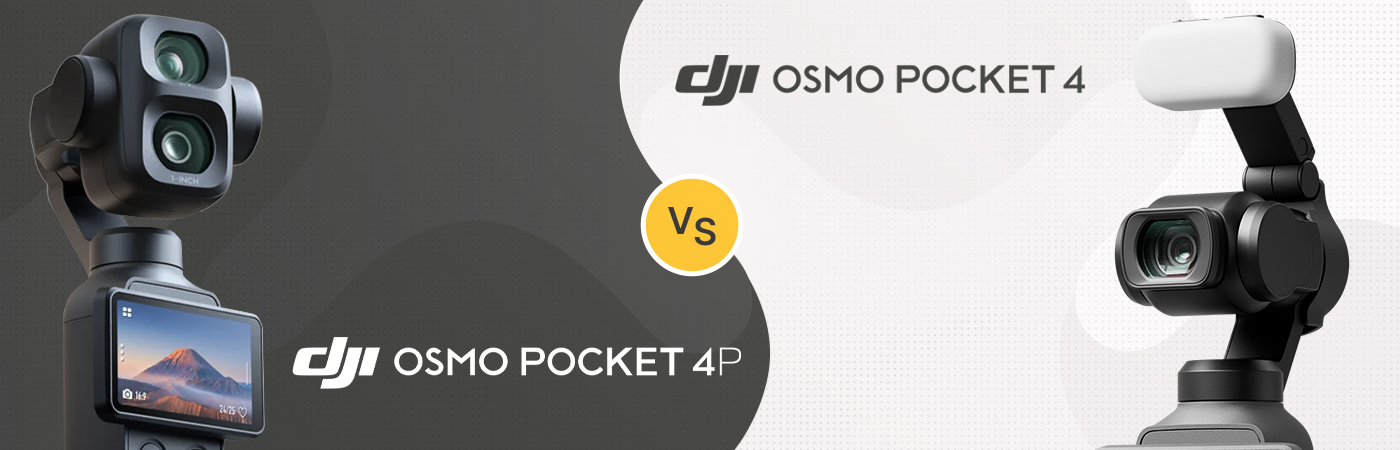
DJI 's Osmo Pocket 4P: Design and Build Quality

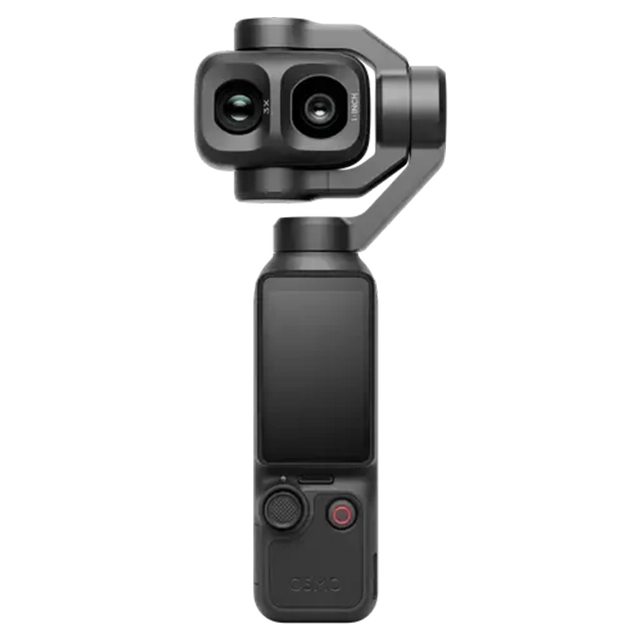
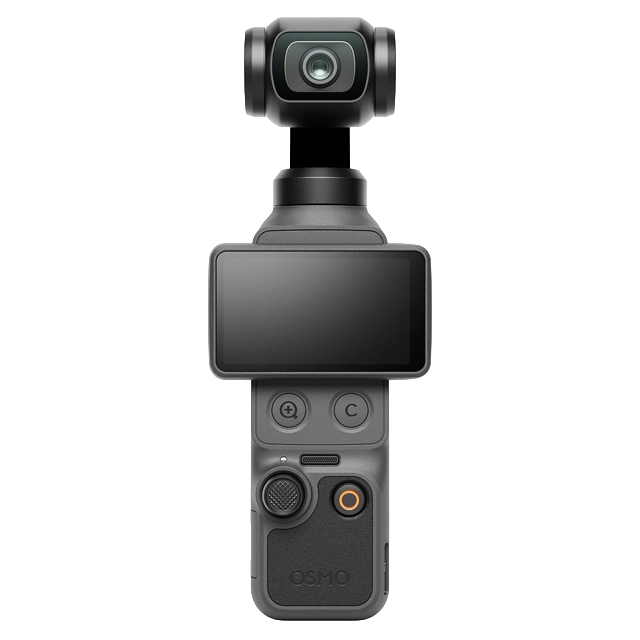
Both devices retain the distinctive design of the DJI Pocket series: a camera mounted on a compact, 3-axis gimbal, a vertical body, and a rotatable touchscreen.
The standard DJI Pocket 4 is lighter and simpler in design.It fits easily into a small bag, a pouch, or a larger jacket pocket.Despite its compact size, you get mechanical stabilization—not just electronic image stabilization.
DJI The Pocket 4P is heavier and more bulky at the top due to the use of two camera modules.It's still a mobile device, but the standard Pocket 4 might be more comfortable for long vlogging sessions with your arm outstretched.
Display and Controls
Both models feature a 2-inch screen with a resolution of 556 × 314 pixels and a brightness of 1,000 nits.You can rotate the screen to quickly change the recording orientation.
There are physical controls below the display.On the DJI Pocket 4P, the left button lets you quickly switch from 1× to 3×, and pressing it twice activates a stronger zoom.The second button can be configured and assigned functions such as changing the gimbal mode, centering the camera, or switching between settings profiles.
In practice, physical buttons are very important.You don't have to tap the icon on the small screen every time you want to change the focal length or restore your saved settings.
Are the DJI Pocket 4 and DJI Pocket 4P water-resistant??
Don't treat any of these models as an action camera.The movable gimbal and exposed lens module require caution during transport, in the rain, and when recording in dusty environments.
If you plan to film while participating in water sports, in heavy rain, or in conditions where the camera might fall onto rocks or sand, a camera from the DJI Osmo Action series might be a better choice. .The Pocket 4 and Pocket 4P are primarily designed for controlled handheld recording.
Features and capabilities
Image Quality and Sensor
DJI The Pocket 4 uses a 1-inch CMOS sensor and a wide-angle lens with a 20 mm equivalent and an f/2.0 aperture. The sensor, which is large for a pocket camera, delivers good image quality both during the day and in more challenging lighting conditions.
The standard Pocket 4 offers up to 14 degrees of dynamic range and 10-bit recording in D-Log profile.In practice, this means greater ability to recover detail from bright skies and darker areas of the frame during color correction.
DJI The Pocket 4P uses an enhanced, 1-inch Stacked CMOS sensor with LOFIC technology in a wide-angle camera.The manufacturer specifies a a dynamic range of up to 17 degrees in the D-Log 2 profile.However, it's important to remember that the most advanced recording settings are available when using the wide-angle camera.
The difference between 14 and 17 degrees won't be equally noticeable in every scene.You'll get the most out of it when recording:
- a person standing against the backdrop of a bright window
- sunset
- interiors and exterior views in a single frame
- scenes with strong spot lighting
- footage intended for later color grading
If you post unedited videos and mainly use automatic settings, the DJI Pocket 4P will offer less of an advantage than it would to someone who consciously works with logarithmic footage.
4K and Slow-Motion Recording
Both models record standard 4K footage in a 16:9 aspect ratio at up to 60 fps./s.This allows you to capture smooth video while walking, traveling, at events, and during dynamic scenes.
DJI Pocket 4 also offers slow-motion recording at up to 4K/240 fps./s.Such a high frame rate allows for very impressive slow-motion effects, especially when filming sports, water, hair, fabrics, and dynamic product shots.
DJI The Pocket 4P also offers 4K/240 fps./s from a wide-angle camera.The 60 mm telephoto lens supports slow-motion recording up to 4K/200 fps./s.
It is worth noting that the designation 4K/240 fps./s does not mean the setting you will use all the time.Such a high frame rate requires a lot of light, quickly fills up the memory, and shortens the operating time.For standard videos, 4K/25, 4K/30, or 4K/50 fps is usually sufficient./s.
Mechanical stabilization
DJI Pocket 4, DJI, and Pocket 4P are, first and foremost, camera gimbals.Mechanical stabilization in three axes physically compensates for hand movements, making the footage look more natural than footage stabilized solely by electronic means.
Both models are ideal for walking, handheld video recording, capturing smooth panoramas, and automatic subject tracking.However, they cannot replace proper technique.When running fast or moving your arm abruptly, vertical movements and foot impacts may still occur.
You'll get the best results if you hold the camera steady, bend your knees slightly while walking, and avoid sudden changes in direction.
ActiveTrack and People Tracking
DJI Pocket 4 uses an advanced tracking and intelligent autofocus system.The camera can keep the selected person in the frame, which is helpful when vlogging on your own, giving a presentation, recording a workout, or creating content without a camera operator.
DJI Pocket 4P expands this system to include tracking multiple people.The camera can detect multiple people and automatically adjust the composition when someone enters the frame.
This is a useful feature for recording conversations, family events, and team activities.However, it is not a magic operator.In low light, when the face is obscured, or when objects are moving quickly, tracking performance may decrease.
Sound
Both models have three built-in microphones and support stereo recording.The cameras can also work with wireless microphones from the DJI OsmoAudio ecosystem.
The built-in microphone is sufficient for quick recordings in a quiet environment.However, if you're recording a conversation, a vlog on the street, or commercial footage, we recommend using a wireless microphone.Good video quality won't save the film if the audio is drowned out by wind and traffic noise.
Storage and File Transfer
DJI The Pocket 4 has 107 GB of built-in storage and supports microSD cards with capacities up to 1 TB.DJI The Pocket 4P offers 103 GB of internal storage and also allows you to expand storage using a microSD card.
A difference of four gigabytes shouldn't affect the purchasing decision.It is much more important to use a fast, reliable memory card, especially when recording 4K footage at a high bitrate.
For regular recording, we recommend using a high-speed microSD card and to back up your footage regularly.
Performance in Everyday Use
Vlogging and Travel
For classic vlogging, the standard DJI Pocket 4 is sufficient in most cases.The 20 mm lens captures the face and a large portion of the surroundings, and the 3-axis gimbal stabilizes the footage while walking.
DJI The Pocket 4P offers greater flexibility, but the 60 mm telephoto lens won't be useful for every shoot.You won't be able to use it comfortably if you hold the camera right in front of you.Its advantages become apparent when you set up the equipment further away, film another person, showcase a product, or are looking for a tighter, more cinematic shot.
You can find more practical information about this application in our article:
A camera designed for vlogging— DJI 's Osmo Pocket 4P
Recording Portraits and Interviews
In this application, the DJI Pocket 4P is the clear winner.
A 60 mm focal length better captures facial proportions, allows you to position the camera farther away from the person you're talking to, and produces a more natural background blur.The f/1.8 lens and separate image sensor mean that this isn't just a digital zoom of a wide-angle image.
For interviews, expert commentary, product features, and short-form documentaries, the additional funding for * DJI * *Pocket 4P* is justified.
Product Videography
Both models offer features that make it easier to display objects located close to the lens.
DJI Pocket 4 works well for large-scale presentations given from the hand.DJI The Pocket 4P also allows you to use the 60 mm focal length for closer-up shots of details.This allows you to show the entire product and then zoom in on buttons, the texture of the material, or small details without having to position the camera just a few centimeters away from the object.
Recording After Dark
Both devices feature a 1-inch sensor, which is large for a pocket camera.DJI The Pocket 4 offers a special mode for shooting in low light, while the DJI Pocket 4P adds an improved main sensor and a wider dynamic range.
However, you shouldn't expect the quality of a full-frame camera.In very low-light conditions, noise will appear, detail will be lost, and image noise reduction will be more pronounced.
You'll get the best results when:
- You'll limit the number of frames to 25 or 30./s
- set the correct exposure
- you'll avoid using the maximum digital zoom
- use available light or a small lamp
Operating Time and Charging
DJI The Pocket 4 offers up to 240 minutes of runtime, while DJI Pocket 4P up to 210 minutes.Both devices have a 1,545 mAh battery and support fast charging up to 80% in about 18 minutes.
The shorter battery life of the DJI Pocket 4P is due to its more sophisticated camera system.The difference may matter when traveling or during an all-day event, but fast charging partially makes up for it.
For extended use, it's a good idea to bring a USB-C power bank or a compatible battery pack.
Pros and Cons of the DJI Pocket 4P
DJI P Pocket 4P: Pros
- a separate 60-mm telephoto lens with its own image sensor
- 3× true optical zoom
- a more natural portrait perspective
- greater flexibility when filming details and distant objects
- up to 17 degrees of dynamic range in D-Log 2
- slow-motion recording up to 4K/240 fps./s
- advanced people tracking
- convenient physical buttons for zoom and custom functions
- its compact size relative to the capabilities of the two cameras
Disadvantages of the DJI P Pocket 4P
- higher price
- greater weight and a more sophisticated camera module
- A shorter stated battery life than the DJI Pocket 4
- The most advanced image profile applies to the wide-angle camera
- Digital zoom does not maintain the quality of the 3× optical zoom setting
- More features may be unnecessary for someone who only records simple vlogs
Pros and Cons of the DJI Pocket 4
DJI Pocket 4 Features
- 1-inch CMOS sensor
- recording up to 4K/240 fps./s
- up to 14 degrees of dynamic range
- 10-bit D-Log profile
- mechanical stabilization in three axes
- longer stated operating time
- 107 GB of internal storage
- a lower price than that of the DJI Pocket 4P
- a simpler and lighter design
- A great choice for vlogging, travel, and everyday recording
Disadvantages of the DJI Pocket 4
- just one wide-angle lens
- no optical portrait focal length
- a more limited zoom range than in the 4P version
- a less natural facial perspective when filming from a short distance
- less flexibility during interviews and product presentations
- a lower dynamic range than the DJI Pocket 4P
Price and Cost-Effectiveness of the Purchase
DJI The Pocket 4 and DJI Pocket 4P are available at the MEGADRON store, but stock is limited for both models.The huge interest in pocket cameras DJI didn't start with this generation—demand has remained very high ever since the launch of DJI Osmo Pocket 3.
When evaluating cost-effectiveness, however, don't focus solely on price or availability.The most important question is: Will you actually take advantage of the additional features of the DJI Pocket 4P while recording??
The upgrade to the DJI Pocket 4P makes sense if you regularly record:
- portraits and on-camera interviews
- interviews
- products and details
- events and people from a greater distance
- travel gear that requires different focal lengths
- scenes where you want a more cinematic perspective
- material intended for more precise color processing
The standard DJI Pocket 4 will be a better value if:
- You record most of your footage handheld
- You mainly create vlogs and travel reports
- You most often use a wide-angle shot
- Do you want a simpler and lighter design?
- Do you want to allocate part of your budget to a microphone, memory card, filters, or an additional power source?
It's not worth buying the DJI Pocket 4P just because it's a more advanced version.Additional features are only useful if you actually use them while recording.
Where to test the DJI Pocket 4 and DJI Pocket 4P?
Technical specifications tell you a lot, but they won't answer every question.It's only when you actually hold the camera in your hands that you can assess its size, how it handles, how the gimbal works, how easy it is to frame shots, and whether you need the additional features of a more expensive model.
At our MEGADRON brick-and-mortar store in Gdynia, you can see and test the equipment before you buy it.We also operate a rental service, so you don't have to base your decision solely on the specifications table.You can try out the camera in real-world conditions and see if it suits your filming style.
We also provide professional consulting services and our own maintenance service.We help you not only choose a camera, but also select a microphone, memory card, filters, lighting, and a power source.Your gear should form a cohesive set—adding random accessories usually ends up costing you money on items you won't end up using later.
For more information about the features of the higher-end model, check out our article “A Camera Built for Vlogging – DJI Osmo Pocket 4P” .
We've compiled detailed answers regarding operation, recording modes, zoom, stabilization, and compatible accessories in a separate guide: DJI Pocket 4P FAQ – Answers to Frequently Asked Questions .
Which model should I choose??
Choose the DJI Pocket 4if you need a lightweight and convenient device for vlogging, travel, family videos, and everyday content posted online.This is a sensible choice for someone who mostly uses wide-angle shots and doesn't need a more advanced camera system.
Choose the DJI Pocket 4Pif you want more freedom in framing your shots and plan to record not only wide-angle vlogs, but also portraits, interviews, products, events, and close-ups.This is a better choice for creators who deliberately use different focal lengths and want to capture more varied footage without having to carry a camera and a separate gimbal.
Our recommendation is clear:
- For vlogging, travel, and everyday recording— DJI Pocket 4
- For portraits, interviews, product shots, and more creative framing— DJI Pocket 4P
Don't pay extra for the DJI Pocket 4P just for the name or a longer list of features.Choose it when its additional features solve a real problem during recording.