

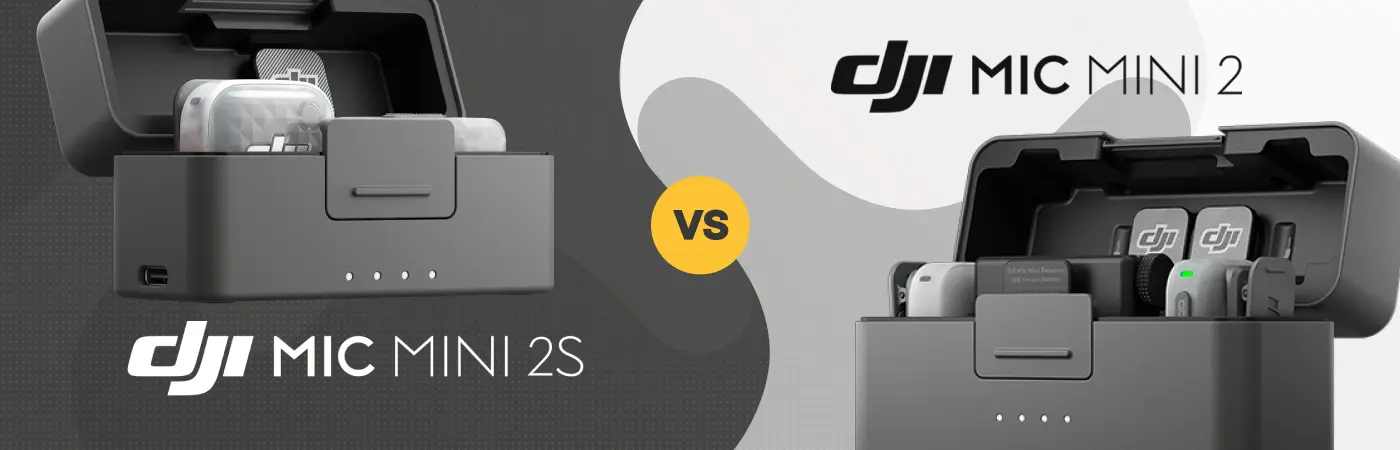
DJI Mic Mini 2S and DJI Mic Mini 2 look almost identical, but are designed for slightly different users.DJI The Mic Mini 2 was released on April 28, 2026, and was designed as a lightweight, easy-to-use wireless microphone for vlogs, short videos, interviews, and live streams.DJI The Mic Mini 2S debuted on August 4, 2026, as a more advanced version that primarily adds internal storage 32-bit floating-point, approximately 14.5 GB of memory, and AI noise reduction , and support for up to four transmitters.
So right from the start, we can draw a simple line.If you need a small microphone for everyday recording and are primarily looking for a good balance between price and performance, the DJI Mic Mini 2 is still a very reasonable choice.However, if you’re recording content that can’t be easily replicated, working with several people, or want to have a backup copy saved directly on the transmitter, the DJI Mic Mini 2S offers much greater peace of mind.
In this comparison, we won't be trying to prove that the newer model is automatically better for everyone.We'll show you what you're actually paying extra for, which features really matter in practice, and when the more affordable DJI Mic Mini 2 will be sufficient.
Check it out at DJI Mic Mini 2S
DJI Mic Mini 2S vs. DJI Mic Mini 2 – Comparison Chart
| Feature | DJI Mic Mini 2S
| DJI Mic Mini 2
|
|---|---|---|
| Release Date | August 4, 2026 | April 28, 2026 |
| Transmitter weight | about.12 g | about.11 g |
| Transmitter Dimensions | 28.58 × 28.04 × 13.52 mm | 28.58 × 28.04 × 13.52 mm |
| Microphone Specifications | omnidirectional | omnidirectional |
| Frequency response | 20 Hz–20 kHz | 20 Hz–20 kHz |
| Audio transmission quality | 48 kHz / 24-bit | 48 kHz / 24-bit |
| Internal Recording | yes | no |
| 32-bit float format | yes | no |
| Transmitter memory | about.14.5 GB | no |
| Maximum internal record length | up to 28 hours.in 24-bit | no |
| Noise Reduction | two levels, AI model | two levels |
| Voice Profiles | Regular, Rich, Bright | Regular, Rich, Bright |
| Maximum number of transmitters with a single receiver | 4 | 2 |
| Modes | Mono, Stereo, Quadraphonic | Mono, Stereo |
| Safety Track – -6 dB track | yes | yes |
| Range with a standard receiver | up to 400 m | up to 400 m |
| Coverage with Mobile RX | up to 300 m | up to 300 m |
| Charging time | 80% in about 18 minutes | 80% in about 18 minutes |
| Transmitter operating time | until 11 a.m.. | up to 11.5 hours. |
| Receiver operating time | up to 10 hours. | up to 10.5 hours. |
| Total time with the large case | up to 40 hours. | up to 48 hours. |
| Bluetooth | 6.0 | 5.3 |
| Fast charging | about.1 hr.5-minute work sessions | about.1 hr.5-minute work sessions |
| OsmoAudio | yes | yes |
| Standalone voice recorder | yes | no |
| Maximum file copy speed | about.34 MB/s | not applicable |
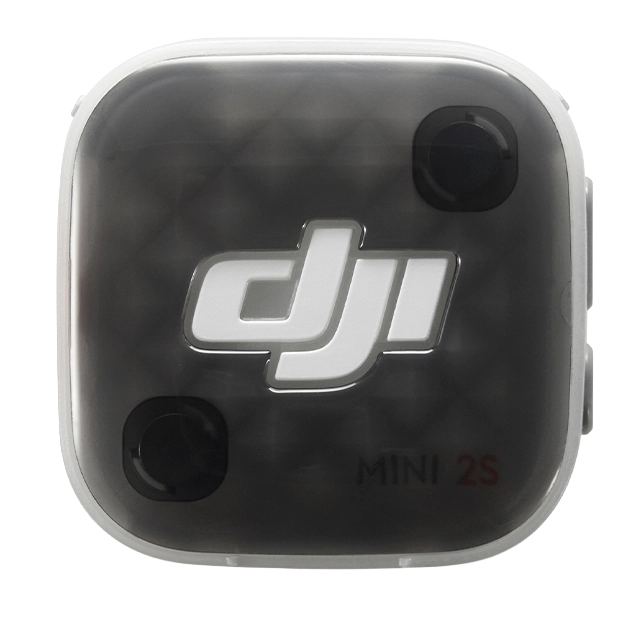
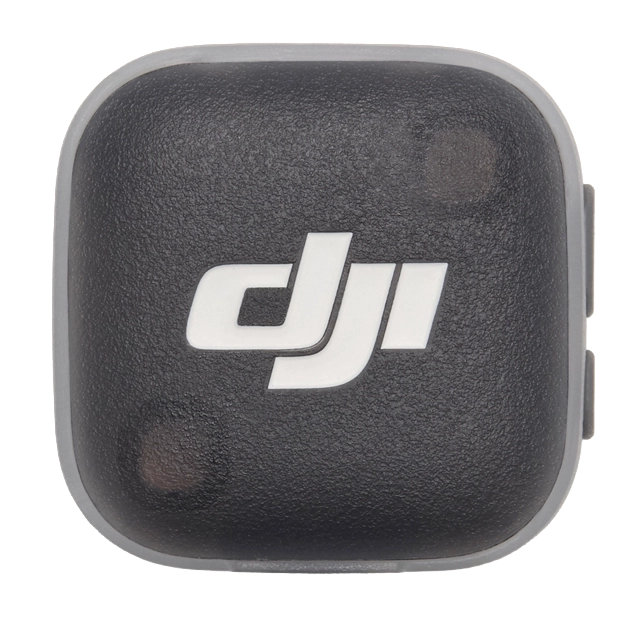
The operating time and range specifications were measured by the manufacturer under controlled conditions.Enabling noise reduction, internal recording, and operating in an environment with multiple wireless networks may affect actual results.
The Key Differences Between the DJI Mic Mini 2S and the DJI Mic Mini 2
The biggest difference does not concern the quality of the audio being transmitted.Both systems can deliver 48 kHz / 24-bit audio, offer omnidirectional pickup patterns, two levels of noise reduction, three voice profiles, and a range of up to 400 m under suitable conditions.
DJI The Mic Mini 2S stands out primarily because of what happens beyond the standard transmission to the receiver.
DJI The Mic Mini 2S records audio internally
The DJI Mic Mini 2S transmitter has approximately 14.5 GB of memory and can record audio directly to the device.In the default 24-bit format, the memory is sufficient for up to 28 hours of footage.The following notation is also available 32-bit floatformat, which provides a wider dynamic range and makes it easier to recover passages that are too quiet or too loud during post-production.
DJI The Mic Mini 2 does not have internal storage.The audio must be transmitted to a receiver, camera, smartphone, or other recording device.Therefore, the transmitter cannot function as a standalone voice recorder.
In practice, an internal provision is relevant in three situations:
- when the wireless connection is temporarily interrupted
- when the volume is set incorrectly on the camera
- when the transmitter is to operate without a receiver as a standalone recorder
When you're vlogging at home every day, you might never need this feature.During a wedding, conference, interview with a guest, or live event, it can save footage that can't be reshot.
DJI The Mic Mini 2S supports up to four transmitters
The standard DJI Mic Mini 2 receiver can work with up to two transmitters.This setup is sufficient for a conversation, a traditional interview, or a podcast hosted by two people.
DJI The Mic Mini 2S allows you to connecting up to four transmitters to a single receiver.This makes it better suited for panel discussions, multi-person podcasts, training materials, and productions in which three or four people speak at the same time.The system can also support four-channel audio output when configured accordingly.
However, this does not mean that simply purchasing a set with two transmitters automatically provides a set for up to four people.Additional transmitters must be purchased separately, and the ability to record four independent channels also depends on the connected device and the adapter used.
DJI The Mic Mini 2S features improved AI noise reduction
Both microphones offer two levels of noise reduction.DJI 's Mic Mini 2 is designed for quieter indoor environments and noisier outdoor conditions.The 2S model uses a new, proprietary AI algorithm designed to recognize speech more effectively and filter out background noises such as fans, air conditioning, reverberation, and traffic noise.
Basic Mode DJI 's Mic Mini 2S mode reduces background noise more gently and is better suited for indoor use.Strong Mode is more powerful and can be useful on the street, at an event, or in a noisy environment.
Our advice: Don't automatically enable the strongest noise reduction.The more processing is applied, the greater the risk that the voice will sound less natural.First, position the microphone close to your mouth, attach the windscreen, and only then adjust the attenuation level.
DJI The Mic Mini 2 has a slightly longer battery life
The newer model doesn't come out on top in every category.The DJI Mic Mini 2 transmitter operates for up to 11.5 hours, while the DJI Mic Mini 2S operates for about 11 hours.The older model receiver lasts up to 10.5 hours, while the 2S receiver lasts about 10 hours.
The difference is also noticeable with a large charging case.The DJI Mic Mini 2 case can charge two transmitters and a receiver approximately 3.6 times, providing a total of up to 48 hours of battery life.With the DJI Mic Mini 2S, this equates to about 3.2 full charges and up to about 40 hours of use.
This is due, among other things, to the use of higher-capacity batteries and additional features in the 2S model.In practice, both systems are sufficient for a long day of recording, but the DJI Mic Mini 2 has the edge if maximum runtime is a priority.
Design and Workmanship
In terms of design, the DJI Mic Mini 2S and the DJI Mic Mini 2 are very similar.Both transmitters measure 28.58 × 28.04 × 13.52 mm.The 2S model weighs about 12 g with the magnetic front cap, and the Mic Mini 2 weighs about 11 g without the magnetic clip and magnet.
A difference of one gram doesn't really matter in everyday use.Both microphones are lightweight, don't noticeably pull on the fabric, and remain almost imperceptible during longer conversations.
Magnetic Mount and Rotating Clip
In both models, the transmitter can be attached using a magnet or a swivel clip.This allows you to clip the microphone to a shirt, sweatshirt, jacket, or other item of clothing, and then point it in the right direction.
This is a good solution, especially when vlogging and recording on the go.The microphone can be attached quickly, without running a wire under your clothes and without using a traditional lapel microphone.
However, it’s important to remember that even a lightweight transmitter shouldn’t rub against the fabric.Friction caused by a collar, scarf, or loose sweatshirt can be more problematic than the difference between noise-reduction algorithms.
Replaceable tips and colored covers
DJI The Mic Mini 2 introduced the ability to change the magnetic front caps and use colored windshields.DJI The Mic Mini 2S builds on this concept and also allows you to customize the transmitter's appearance to match your clothing, brand identity, or the nature of the content being produced.
This feature does not affect the quality of the recording, but it may be important for people who regularly appear on camera.Different colors also help identify transmitters assigned to specific callers.
Charging Case
The large case for both systems measures 106.30 × 42.50 × 59.20 mm and has a capacity of 1,950 mAh.The DJI Mic Mini 2 case weighs about 159.3 g, while the version for the DJI Mic Mini 2S weighs about 160 g.
DJI 's Mic Mini 2S case also plays an important role in the workflow for internal recordings.Once connected to a computer or compatible smartphone, you can copy files from the transmitters at speeds of up to about 34 MB/s.According to DJI, transferring 30 minutes of 24-bit audio takes about 8 seconds under the right conditions.
Features and Capabilities
Audio quality: 48 kHz / 24-bit
Both the DJI Mic Mini 2S and the DJI Mic Mini 2 can transmit audio at 48 kHz / 24-bit quality.Both have an omnidirectional pickup pattern, which allows them to pick up sound from various directions and does not require as precise positioning as directional microphones.
In practice, the quality of the material will be determined to a greater extent by:
- the distance between the transmitter and the mouth;
- method of attachment;
- gain level;
- room acoustics;
- the wind and ambient sounds;
- noise reduction settings.
The fact that the Mic Mini 2S uses a 32-bit float format in DJI does not automatically mean that the voice will sound richer than on the Mic Mini 2.Its main advantage is greater flexibility during processing and protection against incorrect recording levels.
Three voice tone settings
Both devices offer three profiles:
- Regular – natural, balanced sound;
- Rich – more pronounced low frequencies;
- Bright – clearer high frequencies and greater clarity.
Profiles can speed up post-production, especially for short videos, vlogs, and live streams that are published quickly.However, they are not a substitute for sound correction.For an important recording, it’s still a good idea to record a short test clip and check whether the selected profile emphasizes sibilants or excessively boosts the low end..
Safety Track
DJI The Mic Mini 2 and DJI Mic Mini 2S support the Safety Track feature in the DJI app. Although.The system records an additional track with the level reduced by 6 dB, which helps protect the audio from sudden volume spikes.
In the DJI, the Mic Mini 2 is the most important backup mechanism.In the DJI, the Mic Mini 2S Safety Track operates alongside the internal 32-bit float recording, which is why the newer system offers more levels of protection.
Clipping Control and Loudness Balance
DJI The Mic Mini 2S offers adaptive gain control with two modes.Clipping Control automatically responds to sudden volume spikes and reduces the risk of clipping.Loudness Balance evens out the signal level, which can be useful during interviews and live broadcasts.
DJI The Mic Mini 2 features automatic level limiting and five-step gain control.So it provides the basic tools for sound control, but it doesn't offer a system as comprehensive as the 2S.
Mono, Stereo, and Quadraphonic
DJI The Mic Mini 2 works well in typical mono and stereo setups.With two participants, you can assign transmitters to separate channels, which makes it easier to adjust the volume later.
DJI The Mic Mini 2S adds a Quadraphonic mode, allowing for independent recording of four tracks in a compatible configuration.This feature is primarily intended for more complex productions.It requires a compatible device, so be sure to check the manufacturer's current compatibility list before purchasing an adapter or camera.
OsmoAudio and Device Compatibility DJI
Both transmitters can connect directly to compatible DJI cameras via OsmoAudio.This allows you to record 48 kHz / 24-bit audio without using a standard receiver.
However, the list of supported devices is not identical.At the launch of the Mic Mini 2, the manufacturer mentioned, among others, the Osmo Pocket 3, Osmo 360, Osmo Nano, and Osmo Action 6.DJI The Mic Mini 2S is also compatible with the newer Osmo Pocket 4 and Osmo Pocket 4P.
Compatibility can be expanded through software updates.Before making a purchase, we always recommend checking the specific camera model rather than relying solely on the OsmoAudio technology name.
Intergenerational Compatibility
DJI The Mic Mini 2 is compatible with the following transmitters DJI, and Mic Mini.The mobile receiver from the DJI Mic series also allows you to create custom configurations in combination with other systems from the same manufacturer.
DJI The Mic Mini 2S remains compatible with Mic Mini and Mic Mini 2 transmitters, and its standard receiver can be used to build a system comprising up to four transmitters.This is good news for people who already own a previous model and want to upgrade it without replacing all the components.
However, not every feature will be available in every mixed configuration.The older transmitter will not gain internal memory or 32-bit floating-point capability when paired with the new receiver.
For more information about pairing, operating modes, and supported devices, see the articles below:
- DJI Mic Mini 2S – Answers to Frequently Asked Questions
- DJI Mic Mini 2 – Answers to Frequently Asked Questions
Performance in Everyday Use
Broadcast Range
When properly configured, both systems offer a range of up to 400 m with a standard receiver and up to 300 m with a mobile receiver.The measurements were taken in an open area free of obstacles and interference.
In the city, in a building, at a trade show, or at a concert, the range will be shorter.Walls, people, Wi-Fi networks, and other devices operating in the 2.4 GHz band can reduce transmission stability.
We would not view the stated 400 m as an incentive to record from the maximum distance.The greatest benefit of a long range is the stability margin of a dozen or so or several dozen meters.
Duration
In terms of battery life, the DJI Mic Mini 2 has the edge:
- transmitter: up to 11.5 hours
- receiver: up to 10.5 hours
- The entire set with a large case: up to 48 hours
DJI The Mic Mini 2S offers:
- transmitter: up to 11 hours
- receiver: up to 10 hours
- The entire set with the large case: up to 40 hours
The differences aren't significant during a single session.Both transmitters should have no problem handling a recording that lasts several hours.However, the Mic Mini 2 will be better for a long trip without access to a power source.
Also, keep in mind that the 11-hour battery life of the DJI Mic Mini 2S was measured with internal recording and noise reduction turned off.Enabling these features will reduce the actual operating time.
Fast charging
In both systems, five minutes of charging can provide about an hour of use.This is useful during a production when, before starting the recording, it turns out that one element of the setup has a low power level.
However, fast charging should not replace proper preparation of the equipment.Before an important recording, we recommend charging the entire system, checking the available storage space on the 2S, and performing a quick sound check.
Automatic Energy Saving
Both models can enter sleep mode when they lose connection with the receiver and automatically resume operation when the connection is restored.An automatic shut-off feature is also available after a specified period of inactivity.
DJI The Mic Mini 2S can also automatically start internal recording, synchronize it with the receiver's operation, or begin recording when the receiver's battery level gets low.This allows a backup to be created without having to manually enable recording each time.
Pros and Cons of the DJI, Mic Mini 2S, and Mic Mini 2
Pros of the DJI Mic Mini 2S
- 32-bit floating-point internal storage
- about 14.5 GB of storage
- Up to 28 hours of 24-bit recording
- can be used as a standalone voice recorder
- Supports up to four transmitters
- four-channel output in compatible configurations
- Enhanced AI noise reduction
- Clipping Control and Loudness Balance
- file transfer speeds of up to approximately 34 MB/s
- Compatibility with older Mic Mini transmitters
Cons of the DJI Mic Mini 2S
- higher price
- a slightly higher transmitter weight
- slightly shorter battery life than the DJI Mic Mini 2
- up to 40 hours instead of 48 hours with the large case
- Internal recording and AI increase energy consumption
- Not every user will take advantage of the four-transmitter configuration
- Quadraphonic mode requires compatible equipment
Pros of the DJI Mic Mini 2
- lower price
- a transmitter weighing about 11 g
- up to 11.5 hours of transmitter operation
- Up to 48 hours of battery life with the large case
- two levels of noise reduction
- three voice tone profiles
- range up to 400 m
- Safety Track with a -6 dB backup track
- OsmoAudio and Broad Compatibility
- a great choice for solo and duet recordings
Cons of the DJI Mic Mini 2
- no internal memory
- No 32-bit float representation
- cannot be used as a standalone voice recorder
- Supports up to two transmitters
- no four-channel Quadraphonic mode
- less protection of the material after loss of transmission
- less sophisticated automatic level control
DJI Mic Mini 2S: Price and Value for Money
When comparing prices, you should compare options with similar features.The model number alone isn't enough—a configuration with one transmitter and a portable receiver serves a different purpose than a set with two transmitters, a standard receiver, and a large case.
As of August 4, 2026, the prices for the DJI Mic Mini 2S at MEGADRON are:
- DJI Mic Mini 2S 2 TX + 1 RX + charging case – 869 PLN
- DJI Mic Mini 2S 1 TX + 1 Mobile RX + case – 459 PLN
- DJI Mic Mini 2S 1 TX + 1 RX – 459 PLN
- DJI Mic Mini 2S single transmitter – 319 PLN
For comparison, DJI The Mic Mini 2 costs:
- DJI Mic Mini 2 2 TX + 1 RX + charging case – 449 PLN
- DJI Mic Mini 2 1 TX + 1 RX – 259 PLN
- DJI Mic Mini 2 1 TX + 1 Mobile RX + case – 259 PLN
- DJI Mic Mini 2 2 TX + 1 Mobile RX + case – 359 PLN
Prices and availability are subject to change.Before publishing an article or making a purchase, it's a good idea to check the current prices on the product pages.
Is the DJI Mic Mini 2S worth the extra cost??
In the 2 TX + 1 RX set, the price difference is about 420 zł.That's almost twice the price of the DJI Mic Mini 2, so the decision should be based on actual use, not just on the fact that the 2S is newer.
A surcharge is justified when:
- You record paid projects
- You cannot reenact an interview or an event
- You need a 32-bit float
- Do you want to save a copy on the transmitter?
- You work with three or four people
- you'll use the standalone voice recorder feature
- Do you want more advanced noise reduction?
If you're recording vlogs, short videos, product videos, or conversations between up to two people, the DJI Mic Mini 2 offers most of the basic features at a much lower price.
Which model should I choose??
Choose the DJI Mic Mini 2S when the security of your recording is a priority
DJI We recommend the Mic Mini 2S to content creators who record interviews, reports, events, podcasts, and commercial content.The internal 32-bit float representation is a real-world safeguard, not a feature added solely for the sake of the specification.
It's also a good choice if you plan to use three or four transmitters.The ability to work independently with a larger number of callers provides room for growth without having to change the entire system.
The most versatile set will be the DJI Mic Mini 2S 2 TX + 1 RX + charging case.For phone calls and solo recordings, the cheaper version is a better choice 1 TX + 1 Mobile RX + carrying case.
Choose the DJI Mic Mini 2 when price and ease of use matter
DJI The Mic Mini 2 is a more sensible purchase for vloggers, beginner content creators, trainers, or anyone who mainly records short clips for social media.It offers 48 kHz / 24-bit resolution, two levels of noise reduction, voice profiles, Safety Track, a long range, and excellent battery life.
You have to accept the lack of internal storage, but it won't be a problem for everyone.If you always record in controlled conditions, can retake a shot, and work with no more than two people, the Mic Mini 2 offers better value for the features it provides..
DJI Mic Mini 2S or DJI Mic Mini 2?
DJI The Mic Mini 2S is a better microphone for the discerning creator, but DJI the Mic Mini 2 remains a more cost-effective choice for most beginners.
We would choose the DJI Mic Mini 2S for footage that we are responsible for presenting to the client or that cannot be recreated.With this setup, the transmitter’s copy function, 32-bit floating-point support, and the ability to expand to four microphones are worth the extra cost.
For daily vlogs, short videos, live streams, and interviews with up to two people, we would choose the DJI Mic Mini 2.It costs significantly less, lasts longer, and still offers enough features to produce very good sound.
Before making a purchase, pay attention not only to the model name, but above all to what's included in the set.Select a standard receiver for a video camera or still camera, and Mobile RX for a smartphone.Buy the two-transmitter set only if you actually record conversations—adding a second microphone “just in case” isn’t always the best use of your budget.